Author Archives: Paul Roberts

Unknown's avatar

About Paul Roberts

Born in New Plymouth, New Zealand. I now live in Orewa, New Zealand

Early European settlement at Tataraimaka and the Taranaki Wars

[Edited 3 February, 2024]

The following is an extract from If walls could talk … Succession.

Ngā Mahanga sells 3500 acres of Tataraimaka, May 1847

Seven years after the New Zealand company purchased the Ngāmotu block, now known as New Plymouth, many European settlers had arrived with over 2000 acres under cultivation between both Māori and European farmers.

The new Governor Sir George Grey started negotiations to acquire more land for the increasing numbers of European immigrants and turned his endeavours to the south west of New Plymouth, This land belonged to the Taranaki Iwi. Two blocks were purchased, the Omata block which was adjacent to the newly evolving New Plymouth town and 3560 acres at Tataraimaka which was sold by Ngā Mahanga, a hapū of Taranaki.

The land at Tataraimaka had largely been deserted by Ngā Mahanga since the musket wars and the devastating invasion from the northern tribes 29 years earlier.

It was described as “beautiful shrubbery” as the majority of it up until the 1818 invasion from the northerners had been extensively cultivated for kūmara and taro. The land had reverted to small scrub but was not in heavy bush as other areas were.

The Tataraimaka block was isolated from New Plymouth with no roads or access other than crossing Māori lands.

Negotiations appeared favourable to both sides with good land suitable for agriculture for the settlers and cash for Ngā Mahanga to aid development of their own land and people with the new technologies and opportunities that arrived with the settlers.

The following is taken from the book Tataraimaka 1847 – 1993, The 1st 146 years composed by Larry Charteris & Anne Marie Ngan.

Sir George Gray, in his first term of office as Governor, visited New Plymouth in February 1847 and started negotiations for acquiring more land, much to the relief of the harassed settlers. In May 1847 Mr MacLean, the Land Commissioner, and Mr Wicksteed for the New Zealand Company, were able to negotiate the purchase of 3,560 acres (500 being added later) of the Tataraimaka Block. Negotiations with 150 members of the Nga Mahanga, the local hapu of the Taranaki tribe, took place daily for a whole week and were finally sealed for 150 pounds when Mr MacLean presented brightly-coloured blankets and other gifts to the leading chief, receiving a Maori spear and a Kaitaka (a bordered mat) in return. These gifts from the chief were the Maori form of surrendering their right to the land sold.

It was stated at the time that government officers had been scrupulous in obtaining the consent of every individual concerned, with the title deeds in Maori signed by men, women and even children. In fact, the conveyance of the block was dated May 11th 1848.

First cattle run holder at Tataraimaka, 1848

George Cutfield was employed by the New Zealand company on their first ship that sailed to Ngāmotu, the William Bryant. He was the Immigration Officer and store keeper and effectively the leader of the settlers and was involved with Dicky Barrett in allocating the raupo huts and make shift accommodation that Barrett had built. This was in March 1841. In the years to come, Cutfield had many leadership roles including, Superintendent of the Provincial Council, (similar to the role of a mayor), 1857 to 1861.

The following is taken from an early newspaper in May 1848:

The frequent occurrence of arrears in payment of Government salaries and other monies in this settlement is again the cause of great inconvenience and disappointment to nearly all classes. And as respects the natives, it is to say the least unlucky, for the period limited in the deed for payment of the second instalment on the land at Tataraimaka now occupied by Mr. Cutfield, J. P., as a cattle run, is past.

Papers Past, May 15, 1848

It would appear that the Crown was slow in paying for the Tataraimaka block due to cashflow, although other publications imply that the slow payment was to ensure the payment went to the correct owners. Full payment however was eventually made.

Tataraimaka and the Taranaki Wars

At the start of the first Taranaki Land Wars in March 1860, George Cutfield was farming and living on his property at Tataraimaka. Cutfield, like the other settlers, had to move off their land for their own safety with their houses burnt in their absence.

In a court reports newspaper article “Taranaki Herald 4th July 1858”, It was proven that some Tataraimaka settlers had shot a heifer belonging to Māori.

Wild cattle lived in the bush around Tataraimaka. They had been introduced to Tataraimaka by Captain Henry King and Cutfield soon after the Tataraimaka land sale was secured. Captain King had imported cattle from Sydney to New Plymouth in July 1842, and along with the cattle that Dicky Barrett had help drove up from Wellington meant the cattle population had bred up both in the domestic herd and the wild escapees by 1858. The wild cattle at Tataraimaka, and indeed all about New Plymouth created problems for the farmers, both Māori and Pākehā, who were attempting to grow crops and did not need wild cattle helping themselves to the potatoes.

This court case between Māori and the settlers was civil and mature according to the article.

The Māori land reoccupation of Tataraimaka was part of the wider political scene during the wars and was not a localised Ngā Mahanga / Settlers argument.

Robert Greenwood, land owner at Tataraimaka, 1850 – 1869

Robert Greenwood purchased his first block of land on Timaru Road, exact date unknown, but directly from the New Zealand Company. He added more land when he purchased some of his neighbours, the Morgans in 1853. His obituary can be read here.

Greenwood was 53 when he arrived in New Plymouth to take up land at Tataraimaka. Nineteen years later, at the age of 72, he was forced by the mortgagee to auction his 442 acre Tataraimaka farm. It must be presumed that the financial burden resulting from the Māori land wars in the early 1860s had some part of the forced mortgagee sale. The purchaser would be James Honeyfield.

Some events from Robert Greenwood’s time at Tataraimaka

April 19, 1857

Robert Greenwood was elected to represent the Omata / Tataraimaka district on the New Plymouth Provincial Council. (equivalent to the New Plymouth District council in 2019). Fellow Tataraimaka farmer George Cutfield JP, was Superintendent of the Provincial Council.

October 1858

The schooner Martha anchored off Tataraimaka and 18 local farmers, including R Greenwood, and T Oxenham, loaded potatoes directly to the vessel instead of the awkward task of transporting the potatoes to New Plymouth with no suitable roading (Papers Past, October 1858).

Oxenham had bought the remaining Morgan land by the river mouth and was Greenwoods brother-in-law.

March 11, 1859

Tataraimaka district of the Taranaki Volunteer Rifle Co had training drills at R Greenwoods farm every Tuesday at 10.00am. Greenwood was an inaugural member of the volunteers.

March 28, 1860

Battle of Waireka where settlers and soldiers fought against Māori from the Taranaki Iwi and Ngāti Ruanui, who came from further south. By this date all the Tataraimaka settlers had deserted their farms for the refuge and presumed safety of New Plymouth.

April 6, 1860

The following is an account after the arrival of the Rev. Mr. Riemenschneider and family, from Warea, as given in The Herald. They were escorted safely to New Plymouth by armed Maori from Warea, nine days after the battle of Waireka.

The destruction of property on the Tataraimaka block is immense; Mr. Greenwood’s house is described as being sacked, and the sides pulled down. Cattle, sheep, and pigs have been shot indiscriminately. All kinds of household property have been carried away chiefly by the Ngatiruanui, who not content with the plunder from the settlers, sacked every Taranaki pa on their way home. The Taranakis [sic] say they cannot quarrel with Ngatiruanui at present, as they will be important allies either in the great struggle they expect to have with the Government or in another expedition to the town. After annihilating us they will have a tone to pick with Ngatiruanui. Both tribes are busy erecting pas.

April 24, 1860

Four weeks after the Battle of Waireka, troops from the 65th regiment marched to Tataraimaka to harvest R Greenwood’s wheat and potatoes. This helped secure food for the sieged New Plymouth, instead of leaving the crops for the Māori (Papers Past).

June 27, 1860

Taken from “The Herald”

A large force of artillery started early this morning to take up position at Omata, to check the onward movement of the rebels. They were seen last night at Wairau, on the beach this side of Tataraimaka, and are believed to be 1000 strong — including women and children who have accompanied this expedition to attack New Plymouth. No less than 10 pas are erected on the Tataraimaka block, 1 on Oxenhams farm and 9 on Greenwood’s farm. These pas are to be occupied in case of retreat, and each is capable of holding 100 men — the pas are all near each other.

Oxenhams farm is the land closest to the Timaru Stream mouth that was formerly half the Morgan land.

September 19, 1860

Troops deployed south. At Tataraimaka they destroy eight of the rebels makeshift pā on Robert Greenwoods farm (Papers Past).

October 22, 1860

Fires were seen coming from R Greenwoods farm. In all, 30 Tataraimaka houses were burnt to the ground by the rebel Māori.

1861

Although short lived, a peace treaty was signed and some settlers returned temporarily.

The following is taken from memories of the Pierce family.
(Where the cemetery is with the farmland owned in 2019 by the Brophy family)

As a young boy John went with the women and children to Nelson for a few months during the Māori uprising in 1860. Back home in 1861 and still amidst troubled times, John as an 11 year old, had the duty to hold a gun while his older sister milked the cow. This was to protect her should Māori come out of the dense bush.

Memories of Hilda

January 1862

The Māori, who have regained occupancy of Tataraimaka, and have claimed it by conquest, have cut out of seeding pasture, a race track on R Greenwoods property. They have invited Europeans to race their horses should they dare (Papers Past). The authorities strongly advise not to trust the Māori or encourage engagement with a race meeting that would imply acceptance of Māori ownership of the land.

January 1863

Robert Greenwood was an advocate for government support to help the farmers rebuild their lives. He appeared to of received some funds earlier than he should have as the conflict in Tataraimaka was not yet over. Scotch thistles had become a major problem weed and the governor had set up a thistle fund to combat it. Whilst settlers were still fighting over the land with the rebel natives, (not all the natives), the scotch thistle was invading the land the settlers had already ploughed. The joke was that the government had paid Greenwood funds to reduce the thistle population but the settlers could not because the rebel Māori still had control of the land, Tataraimaka had in fact become a large scotch thistle nursery funded by the government (Papers Past).

110 years later, on the same land, Kevin Honeyfield can recall grubbing 300 thistles to the acre, no laughing matter.

June 4, 1863

Battle of Katikara, this was a major defeat for the rebel Māori. Troops had positioned themselves at the crows nest and with naval canon support defeated the rebels on “Johnnys Flat”. This is the flat land west of the Katikara river that the Lawn family own in 2019.

March 1864

The Kaitake Pa was stormed and captured. This Pā was a major stronghold that had prevented safe, easy passage from New Plymouth to Tataraimaka.

1865

Progressively the settlers returned to their land in Tataraimaka to rebuild houses and to restock their farms.

January 23, 1869

At a mortgagee sale, Robert Greenwood sold his farm, including a new house, to James Charles Honeyfield.

It is worth noting the impact of war on the financial fortunes of different settlers.

  • Robert Greenwood had his buildings burnt, stock stolen or slaughtered and no farm income for many years with debt to service. Bankruptcy followed.
  • James Honeyfield had fought in the same battle ground on the same side as Robert Greenwood.
  • James Honeyfield was a farmer and a butcher in New Plymouth. He had the use of the Barrett legacy land. Up to 2000 troops needed feeding over many years. The suppliers to the army reaped the financial benefits.
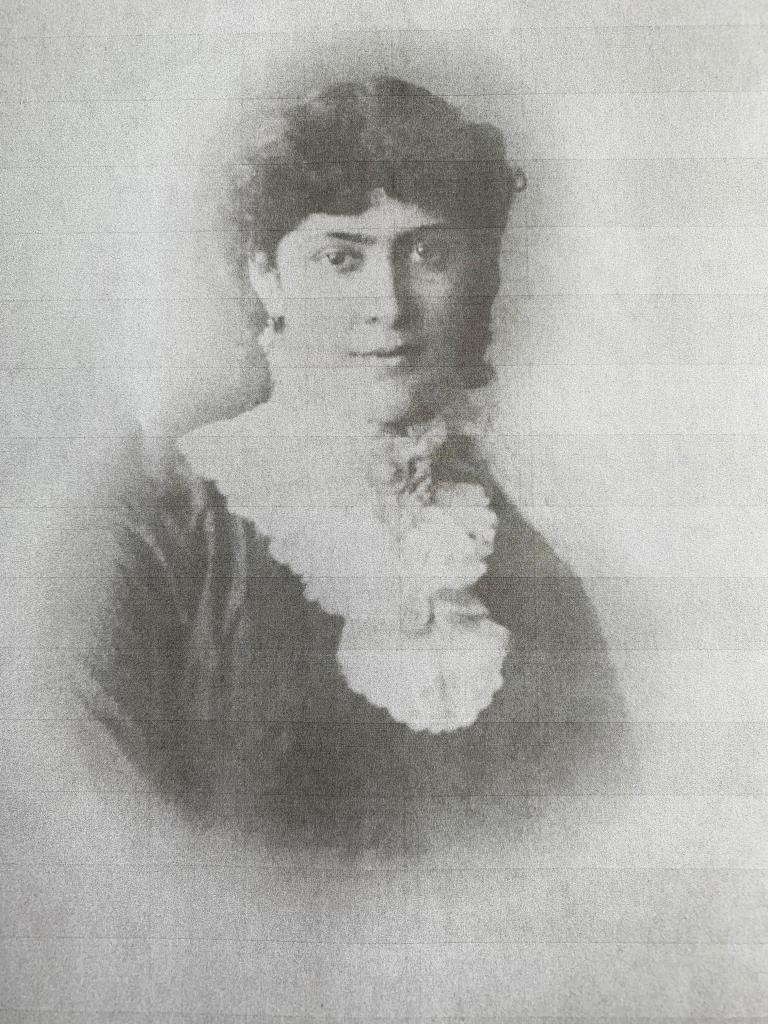

Octavia Lavinia Johns (nee Honeyfield)

The following was written by Julie Adele Johns (Octavia’s great granddaughter) as a contribution to the, ‘If walls could talk … the Stories’ document prepared for the Honeyfield 150 celebrations.

Octavia Lavinia Johns (nee Honeyfield)

‘Octavia Lavinia Honeyfield, the eldest child of James Charles Honeyfield and Caroline ‘Kararaina’ Honeyfield (nee Barrett), was born on the 17th December 1865 at Moturoa, New Plymouth and baptised on Boxing Day that same year by the Reverend John Whitely who had also married her parents earlier that year on 2 January, 1865. James and Caroline later moved to Tataraimaka where Octavia grew up with her younger sister Sarah and brothers Barrett, William and Charles.

On the 19th January 1884 Octavia, aged 18 years, married Thomas Edward Johns aged 21 years at her parents’ homestead on their Tataraimaka farm. Thomas was born in Liverpool, England and had been living in New Zealand for about 18 months before their marriage. Their first child Edgar was born later that year.

That same year on the 19th June 1884 Thomas filed for bankruptcy and on the 16th June 1884 a meeting of his creditors was called. Prior to Thomas’s bankruptcy he had been farming on a large scale without any previous experience and had suffered many losses, also having had the misfortune of a house fire on 22 June, 1883. According to a court hearing on 22 January 1885 Thomas was at that time living with his father-in-law James Honeyfield and no doubt along with Octavia and baby Edgar too. As reported in the newspaper his father-in-law had offered to pay Tomas’s creditors 10 shillings in the pound, but they declined this. Later that year on 22 October, 1885 an order was made for Thomas to be discharged from bankruptcy.

On the 29th July 1886, as reported in the newspaper, Thomas was farming at Moturoa. He and some natives had exchanged a pair of working bullocks and the Maori had returned to revoke the transaction – all ended peacefully.

Octavia gave birth to twelve children, six of who survived into adulthood and six who sadly did not which unfortunately wasn’t uncommon in those times.

Besides Octavia suffering the heartbreak of the loss of five of their children during her lifetime she also had grief and strife in her marriage too. On the 27th November 1894 her husband Thomas appeared in the New Plymouth District Court for drunkenness and as reported in The Taranaki Herald with the likelihood of another charge being laid, that of inflicting grievous bodily harm on his wife. On the 3rd December 1894 Thomas once again appeared in court no doubt as a consequence of what had taken place earlier. This time a prohibition order was issued against him, to which it is reported Thomas himself had no objection. It was suggested that the order should take effect throughout the provincial district, to which James Honeyfield, father-in-law of the defendant, also expressed that this was his wish also. The court granted the order accordingly for twelve months.

A year later Octavia gave birth to their tenth child, a son who was named Thomas Edward James after this father and grandfather James Honeyfield. Octavia then went on to give birth to Ronald who sadly passed away two weeks later. A month after Ronald’s death Thomas was again adjudged bankrupt on the 28 October 1897. His occupation was given as butcher and that he was residing in Blagdon at the time. Lastly the twelfth child of Octavia and Thomas was born who they named Bernard. Sometime after this Octavia’s husband Thomas Johns was paid by James Honeyfield to leave New Zealand so I was told by my grandmother Daisy Johns who had married Edgar Johns (the eldest child of Octavia and Thomas) and that Thomas was what they called a Remittance man. Thomas went to Australia where he remained for the rest of his life.

Sadly approximately 18 months after James’s wife Caroline Honeyfield died on the 12th November 1899 he was again having to write an obituary this time for their beloved daughter which read:

“Death of Mrs Thomas Edward Johns. Octavia Lavinia died in New Plymouth Hospital Tuesday, 14th May 1901 aged 35 years. Mrs Johns had been suffering from typhoid and the complications that followed the dread disease for some considerable time and her death was therefore not unexpected”.

Octavia’s death certificate stated she had been ill for eleven weeks. The surviving children’s ages were listed as five males aged 16, 13, 9, 5 and 2 years, two females aged 11 and 8 years at the time of her passing. From the newspaper at the time it reports that:

“… the deceased was well known and esteemed by a large circle of friends and that her relations will have much sympathy in their sad bereavement. The internment will be private.”

This now left the Johns children without their dear mother, it is unknown whether Thomas had already left for Australia or not.

Tragically Octavia’s last-born child Bernard died at the age of seven years at Moturoa four and a half years after this mother had passed away and it is known Thomas had left for Australia by then.

Octavia’s only sister Miss Sarah Honeyfield (who never married) helped bring up her nieces and nephews. It was history repeating itself as Caroline and James Honeyfield had also helped Sarah Mary Honeyfield (nee Barrett) raise her children when their father William Henry Honeyfield had died also of typhoid fever thirty-seven years earlier. ‘Aunt Sarah’ as she was called remained living on the Bell Block farm with the Johns’ whanau until shortly before she passed away having been taken prior to her death on 3rd March 1932, aged 64 years, to the Tataraimaka farm where she had grown up. Octavia’s children loved their Aunt Sarah very much and even Octavia’s grandchildren remembered her and spoke of her with deep affection which is how she is still remembered to this day.

According to New Plymouth District Council (NPDC) burial records permission was granted for Bernard to be buried in the same large James Honeyfield plot at Te Henui cemetery where his grandmother Caroline had been interred earlier. Although Bernard has no headstone to mark his grave neither can a headstone be found for his mother Octavia or any of her young deceased children. The NPDC has a receipt for 10 pounds having been paid for Octavia’s grave to be dug at Te Henui cemetery. Octavia and her young children are all listed as having been buried there but unfortunately other records have been destroyed by mould (such as plot numbers) plus the undertaker’s records have long since ceased to exist. Along with the NPDC burial staff we can only presume, since they are nowhere else to be found in Te Henui cemetery, that they are all buried together in the James Honeyfield plot as the NPDC believed it was purchased around the same time as William Henry Honeyfield’s plot was bought when he died in 1864. The reason for Octavia and her six young children having no headstones remains a question and any answer is conjecture. Unfortunately, my grandfather Edgar Jules Barrett Johns, Octavia’s eldest son, would have known the answers to many of our questions, but he died when my father Montague Honeyfield Johns (known as Monte) was only eight years old so any information concerning their graves was not passed down. It is my heartfelt desire being one of Octavia’s great grandchildren that it only be fitting that a small plaque be placed in their memory at the James Honeyfield site, so Octavia and her young children are not forgotten through time.

On the 19th July 1933 a letter was sent by Thomas Edward Johns senior to solicitors in New Plymouth, copies of which were handed to the Johns children. Thomas expressed his sadness at having recently received a letter from the Public Trustee informing him of his son Bernard’s death which had taken place 28 years earlier and the recent death of Miss Sarah Honeyfield. Thomas expressed his desire to hear from his children and wanted to see them again since he was now nearing 73 years of age, and in his own words, “But like Johnny Walker am still going strong”. He especially wanted to know how Bernard had died, asking after Effie, Vera, and Edgar although he supposed he would never see or hear from them again. Thomas finished his letter with a postscript, asking the solicitors to oblige him by letting him know how the children were, saying “… you will do me a great kindness”. When this letter was written unbeknown to Thomas his eldest child Edgar had passed away two years earlier aged 47 years. Two of Thomas’s other sons known as ‘Charlie and Tommy’ had gone to live in Australia as adults but to our knowledge never contacted their father. According to Thomas Edward Johns senior’s death certificate which lists his first marriage to Octavia and names their five surviving children it also says that Thomas went on to marry a second time to Anne Fanny Williams who already had a daughter but there were no children from their union. Thomas senior lived out the rest of his life in Australia dying in Murrurundi, NSW on 9th June 1943, aged 80 years. To this day no photo survives of Thomas senior that has been passed down through the Johns whanau which speaks volumes!

James Charles Honeyfield died on 21 February 1911 aged 71 years. In his will he remembered the children of his late daughter Octavia Lavinia especially making provision for his grandsons Edgar, Charles, Oscar and Thomas Johns.

This has been a sad story to write and reflect on, not only because it is true, but Octavia and Thomas are also my ancestors/tupuna, so it is very personal to me along with the rest of the Johns whanau. We exist today because of these people who are our direct heritage line/whakapapa. I have been both factual and fair in giving this account.

Should you wish to find out more information regarding the court cases, Google search ‘Papers Past’ using the dates I’ve given for reference.’

Children of Octavia Lavinia Johns (nee Honeyfield) and Thomas Edward Johns

  • Edgar Jules Barrett Johns
    • Born: 30.09.1884 /30.11.1884
    • Married: Daisy Amy Fuller 09.11.1916
    • Farmed at Bell Block
    • Died: 19.12.1931, aged 47 years
    • Buried: St Lukes cemetery, Bell Block 21.12.1931
  • William Charles Johns
    • Born: 08.12.1885
    • Died: 29.01.1886, aged 7 weeks
    • Buried: Te Henui cemetery 30.01.1886
  • Lina Hannah Johns
    • Born: 08.01.1887
    • Died: 21.03.1887, aged 9 weeks (at Blagdon farm)
    • Buried: Te Henui cemetery 22.03.1887
  • Charles Barrett Johns (known as Charlie)
    • Born: 08.12.1888/28.04.1888?
    • Migrated to Australia
    • Married: Cecilia (known as Sis)
    • Died: 21.03.1951, aged 64 years? Queensland, Australia
  • Victor Barrett Johns
    • Born: 04.02.1889
    • Died 06.09.1892, aged 3 years 7 months
    • Buried: Te Henui Cemetery 07.09.1892
  • Effie Hilda Johns
    • Born: 03.02.1890/ 24.05.1890?
    • Married: John Ambrose Heskett
    • Died: 17.12.1963, aged 72 years Headstone inscription reads 1890- 1963
  • Oscar Harold Johns
    • Born: 02.09.1891
    • Married: Kathleen Doris Mace 02.05.1921
    • Farmer, furnace man, businessman, soldier – Private in Wellington Infantry Regiment. WW1 Service no.69491 NZ Expeditionary Force
    • Died: 19.12.1960, Huntly, NZ
  • Vera Sarah Johns
    • Born: 20.01.1893
    • Married: George Victor Weir 26.03.1913
    • Died: 1952? 12.1957?
  • Doris Octavia Johns
    • Born: 26.03.1894
    • Died: 21.06.1894, aged 3 months
    • Buried: Te Henui Cemetery 22.06.1894
  • Thomas Edward James Johns Junior (known as Tommy)
    • Born: 30.11.1895
    • Migrated to Australia
    • Married:
      • Ist wife, Ruby Elizabeth Fitzgerald
      • 2nd wife, Olive Edna Ellan Archer
    • Labourer and clerk
    • Died: 19.08.1964, aged 68 years, Queensland, Australia
  • Ronald Edward Johns
    • Born: 13.09.1897
    • Died: 28.09.1897, aged 2 weeks
    • Buried: Te Henui Cemetery 30.09.1897
  • Bernard Edgerley Johns
    • Born: 04.01.1899
    • Died: 15.11.1905 at Moturoa, aged 7 years
    • Buried: Te Henui Cemetery 17.11.1905. Funeral left from Mrs Ellen Caroline McLean’s (nee Honeyfield) residence at Moturoa. Recorded permission given for Bernard to be buried in the James Charles Honeyfield plot.

Pre-European Tataraimaka: of fishing, gods, great waka and musket wars

Tataraimaka first became home territory to the Honeyfields close to 170 years ago when William Honeyfield purchased a farm there in 1852. William joined his cousins, John and William Morgan, who made their first purchase in Tataraimaka in 1851. While William and his wife Sarah sold up to farm the Barrett Reserve land in New Plymouth, there has been a permanent Honeyfield presence at Tataraimaka for 150 years, since James and Caroline purchased their farm in January 1869.

Of course, for centuries before the Europeans arrived at Tataraimaka that land had been the home of the tangata whenua. The following captures a little of that story,

(The following is an extract from ‘If walls could talk … Succession’ written by Kevin Honeyfield as part of the Honeyfield 150 celebration)

According to an ancient Maori story, Tataraimaka was a giant who fished with an enormous black net. His black net was magic and had been woven from flax.

One day, a mother said to her little fishes, “Now listen carefully, dear children, be sure you keep close in to the rocks. Do not venture out into the open sea. Today Tataraimaka goes fishing”.

Tataraimaka fishing


On this day however the sea was smooth, the sun was at its brightest. Rainbow colours danced about the little fishes as they played their games. They were having so much fun they forgot their mother’s words.

Without warning disaster struck. The big black net of Tataraimaka hit the water and all seven fishes were caught. They cried, making the sea salty with their tears.

Tane the God of forest and light heard their cries and felt sorry for them. He took the net away from Tataraimaka and hauled it up into the high heavens.

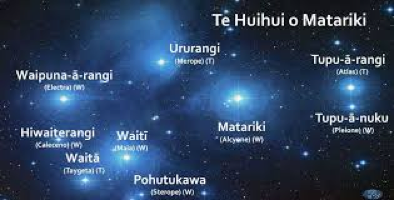
There the seven little fishes were turned into stars. Look to the west, you can see them in the evening above the horizon. Six of the stars have names – but one star remains nameless.

The constellation known as Matariki to the Maori, is known as Pleiades to the Greeks on the other side of the world. 
Maori used this group of stars to help navigate their way to Aotearoa (New Zealand)

It has been left for all the children of the world. Just before going to bed, you may put your name on this star, and in this way you will be among your friends as you sleep.

Possible reasons why our home farms are called Tataraimaka include:

  • Did it come from Tataraimaka, the Giant fisherman in the ancient Maori story?
  • Was it the name used by “The people of the land” the tangata whenua as suggested by Roy Komene at the Tataraimaka Hall Jubilee in 1994? Roy spoke of the people that resided in Tataraimaka years before the Maori arrived, the Kahui-maunga.
  • Its been recorded in many publications that Tataraimaka means “to toss the garment”. Is this simply the feeling given to Tataraimaka after the northern tribes conquered Nga Mahanga?
  • Twenty years before his death Alan Fisher informed Kevin Honeyfield that many years ago some elder Maori had claimed the full name of Tataraimaka was in fact Tataraimaka-moana. Loosely translated meaning a “Beautiful place by the Sea”.

Today, in the year 2019, the families that live in Tataraimaka are less concerned about the meaning of the name. There is more concern about retaining the name and the depth of heritage that Tataraimaka offers.

‘The Broken Canoe’

Laden with people and stores, a fleet of waka that had woven sails set off from Tahiti to make Aotearoa their new home. Three hundred years earlier, Kupe had told his people about his discovery of a vast new land in the South west Pacific, until now only a small number of waka had tried to make this journey.

One of the wakas was the Kura-haupo, this is the canoe that the Maori who later lived at Tataraimaka set sail on. Te Moungaroa was the leader of this waka that had a 5000 km journey to make.

The fleet got separated in the great ocean but three of the waka met at Rangi-tahapa Island, just 1000 km away from Aotearoa. Here the waka Kura-haupo was smashed by the big surf. Te Moungaroa and some friends joined the other two waka, leaving others behind to try and fix the broken canoe.

Te Moungaroa and his followers reached Aotearoa and eventually settled at a beach they called Oakura. They landed by the mouth of the Wairau Stream where the surf club is today.

Here they made their new home, amalgamating with the Kahui-maunga people. These were the people living in Aotearoa before the fleet of waka arrived.

Five hundred years later, some Taranaki Maori still referred to the Kura-haupo as the “Broken Canoe, the canoe that Nga Mahanga from the Taranaki iwi originated from, but a canoe that never arrived in Taranaki.

Another canoe from the fleet, Tokomaru, settled a little further north, forming the Te Atiawa iwi. This is the main blood line that Rawinia, wife of Dicky Barrett, ancestors that the Honeyfields are descended from.

Nga Mahanga

With good land and plenty of food the Taranaki iwi flourished. Two hundred years and seven generations after the landing at Oakura of Te Moungaroa and his friends around 1350, twin boys were born and they named their sub hapu Nga Mahanga, the name for twins. They lived in a pa called Matai-whetu and this was not far from the main Tataraimaka Pa site.

The twins were great warriors and had the following saying which refers to their courage and likens them to the mussels that adhered to the rocks, for they could not be removed from their pa by their enemies.

E Turi’ a Tai! E Hotua Tai! Mara a Tai! Te toka i tauria e te kukwpara, araio mimingo. Kit tu matou ko aku tama, he whetu kau;

Nga Mahanga become the dominant hapu in the Tataraimaka and surrounding area. Sometimes friction arose between them and the iwi to the north, Te Atiawa.

This friction continued for many generations although there were also peaceful times with marriages between them, especially around the Ngamotu area.

Nga Mahanga rohe at Tataraimaka

The Northern Invasion, Summer of 1818

For many generations the hapu of Nga Mahanga flourished at Tataraimaka, with fresh water from the mountain streams, an abundance of sea food and kind forgiving land to grow kumara and taro.

Little did they know, a large war party had come by waka from Kaipara and Tamaki and were resting north of Waitara, hosted by their allies Ngati Tama, who were foe of Nga Mahanga.

Muru-paenga was one of the most feared chiefs of this, the ‘Musket war’ years. He was an ally of Te Rauparaha but an avid enemy of the infamous Honi Hiki.

Overland the war party marched on to Tataraimaka. Nga Mahanga had not encountered the musket before. The hostile northern maori, led by Muru-paenga, advanced towards the Tataraimaka Pa in a wedge shape formation. Some Te Atiawa also accompanied the attackers, pointing out Nga Mahunga chiefs, making them the first casualties to fall to Muru-paenga’s muskets.

If Te Atiawa had not helped Muru-paenga they could of been his next meal, and this is exactly what happened to many of Nga Mahanga.

Great slaughter followed with the spoils of war being flesh, kumara, woven garments and slaves going to the northern attackers.

The surviving Nga Mahanga left Tataraimaka, never to return as residents.

Edmund and Catherine Honeyfield

Updated 8 March 2025

Edmund Morgan Honeyfield was born at Gillingham, Dorset in 1841 and was the 10th child of John and Hannah.

Edmund was considered a delicate child and the family thought the New Zealand climate would be beneficial. His brother Henry John returned to England in 1855 to marry Eliza Read. Edmund aged 15, travelled with them to New Zealand on the Ashmore in 1856.

In 1877 Edmund married Catherine Gane from Mells, Somerset. She had means of her own. They farmed at Whenuakura near Patea in South Taranaki. They called their house Park Farm.

Edmund went on to serve in local government in a number of ways. He was elected to newly established Patea West Road Board in July 1875; the Patea County Council in December 1876; and the Patea Harbour Board in March 1877, serving in each case alongside his cousin Edmin R Morgan (Source: Andrew Morgan).

Edmund’s cousin John Morgan in his writings mentioned visits to Park Farm in 1895:  “Thursday I was at Park Farm, stayed the night, after breakfast I took a walk on the farm, it looks grand, but grass is very short, about all day at the farm.  ……Friday Cecil Honeyfield started for Wanganui, he promised to visit Newtonlees and to stay a few days helping if required.  ……Saturday I found Mrs Honeyfield fully engaged in the baking establishment, there I found a capital old fashioned brick oven all aglow, various dishes and dough worked into loaves, confectionery all ready for the oven.”

Edmund and Catherine had 11 children who became known as the Patea Honeyfields:

  1. Cecil Reginald, born 1878, died 1958. Married Katherine Wright. They farmed at Park Farm, Whenuakura until 1948 when they retired to Patea.
  2. Clara Isabel, born 1879, died 1968. Did not marry.
  3. Lena Eveline, born 1881, died 1967. Married Harry Bradmore.
  4. Leonard, born 1882, died from a farming accident in 1940. Married Elsie Finch and farmed at Patea. In 1918 Leo served overseas in World War 1 in the 30th reinforcements of the Wellington Mounted Rifles. Leo and Elsie had two sons, Ray and Geoff.
  5. Edith Mildred, born 1883. died 1970. (Edith) Mildred went to England in the 1920s. Later she married Ernest Morris at Buckhorn Weston Church, 1925. She lived in England until after the Second World War when she returned to New Zealand.
  6. Irene Katherine, born 1885, died 1947. Married Stewart Wickstead.
  7. Ivo, born 1887, died 1969. Married Prudence Simmonds. Farmed at Patea. Their only child Kenneth also farmed at Patea.
  8. Violet Suzie, born 1889. Married Cyril Langdon Dymock in June 1909. He managed the Bank of New Zealand branch at Taihape where Violet was a teacher.
  9. Alice Muriel, born 1891, died 1964. Married Herbert Hereward Edwards of Stoke, Nelson, where they settled.
  10. Earle, born 1892, died 1893.
  11. Victor Maurice, born 1895, died in 1916 of tuberculosis.
Edmund Honeyfield and family, 1903. Back row: Leonard, Lena, Ivo, Catherine (Mother), Clara, Cecil, Mildred. Front row: Irene, Edmund (Father), Alice, Violet, Maurice


Wakaiwa Rāwinia’s Āti Awa hapū connections

Updated 26 May, 2025

Introduction

The hapū was the main social unit of traditional Māori society and it remains a fundamental organising institution for whānau groups today and is central to establishing one’s Māori identity. Melissa March wrote that:

In understanding the process of self-identification within a Māori context, it is vital to have an understanding of the individual’s place within their whānau/hapū/iwi and the wider community … for most Māori, knowing ones ancestry is of the utmost importance … Turangawaewae represents one location where an individual can say ‘I belong here’.

(M Marsh, 2010: pvii & 1)

Researching Rāwinia’s whānau/hapū connections has been one of the more challenging aspects of my research for this website. Complexities have included the multiplicity, intermingling and migrations of kinship groups in pre-European times; the loss of hapū that ceased to exist after a period following the arrival of Europeans; tribal and hapū configurations that became prone to change during the mid to late 19th century; and many references in the research of others claiming that Rāwinia belonged to the Ngāti Te Whiti hapū, although establishing whakapapa links in that regard has proven to be problematic.

Hapū affiliations were complex, overlapping interests and allegiances that fluctuated over time. Many of our tūpuna identified themselves according to the situation in which they were operating at the time (personal correspondence with Hilary & John Mitchell, October 2019).

Another possible reason for the many connections claimed is that Māori traditionally carried blood relationships to the tenth or twelfth cousinship or further (Smith, p171). Some of that detailed knowledge has either been lost or has not yet surfaced in my research.

Another factor that would support close kin ties between hapū within Te Atiawa may have arisen from the population recovery of the tribe following almost being wiped out by the Nga-Potiki-taua in the 17th century.

Marsh observed that ‘over the years a mass of information had been lost through such things as the Land Wars and the suppression of Māori within Taranaki’ (2010: 3).

Percy Smith (1910) recorded 13 ‘divisions of Ati Awa’ [sic] in his History and Traditions of the Taranaki Coast, including:

  1. Hamua
  2. Ngāti Rāhiri
  3. Ngāti-Tawake
  4. Ngāti-Ue-nuku
  5. Puke-rangi-ora
  6. Puketapu
  7. Ngāti-Tawhiri-kura
  8. Kai-tangata
  9. Manu-Korihi
  10. Ngā-Motu
  11. Otaraua
  12. Ngāti-Tuparikino
  13. Ngāti-Tuahu.

At least six of the above are connected with Wakaiwa Rāwinia. Only the seven shown in italics above are recognised by Kotahitanga o Te Atiawa as one of their tribal hapū today. Ngāti Te Whiti, also recognised as one of the seven Atiawa hapū today, not listed by Smith, may have been regarded at that time as part of the Ngāmotu hapū.

Demise of some hapū

During the 1860s Native Land Court claimants were required to provide tribal and hapū details to substantiate kinship attachment to land (established under the Native Lands Act 1865, the court provided for the conversion of traditional communal landholdings into individual titles making it easier for Pāhehā to purchase Māori land). Extensive evidence presented to the court suggested a multiplicity of kinship groups had existed within Te Atiawa (Keenan, 1991) which no doubt clouded the establishment of proprietary rights to land and resulted in some hapū loosing their ancestral land.

In his research of the Hauraki area, Paul Monin estimated that hapū usually comprised 40 – 60 family members (2006, page 14). Using that as a guide there may well have been in excess of 50 Ātiawa hapū in Taranaki in the early 1800s.

Extensive land sales to the Crown during the 1840s and 1850s contributed significantly to the demise of some hapū. Confiscations of land by the Crown following the Land Wars of the 1860s also had devastating consequences for many hapū.

According to research by Leanne Boulton, mistrust between the settler community and Te Atiawa presence and their reserves utimately led to the retreat of Te Atiawa communities from the city of New Plymouth (2004, piii), further alienating hapū from their ancestral lands.

Ngāti Taweke

Ngāti Taweke is one such hapū that is no more. Wakaiwa Rawinia’s links to Ngāti Taweke go back at least to Korotiwha (circa 1600) and the sucessful restoration of Te Atiawa lands from the Taranaki iwi (see posting on Wakaiwa’s Tūpuna).

Moving forward to the 19th century, Government land agent Donald McLean, in his census of 1847, regarded Ngāti Taweke as still one of the primary hapū of the area between the Waiwakaiho and Waiongana rivers. Its members continued to claim mana whenua through to the 1860’s. However, the hapū’s demise seems to have been rapid as it did not appear in the census of 1874, becoming instead absorbed into the Puketapu hapū in consequence of its traditional mana whenua passing from its control (ibid, p196).

Ngāmotu

Ngāmotu is another of the earlier Te Atiawa hapū recognised by Te Atiawa. The hapū is regarded as a kinship group by the Ngāti Te Whiti.

The Ngāmotu area was popular in traditional Māori society due to the excellent fishing grounds around the Sugar Loaf islands. At different times the area was occupied by either Te Atiawa or Taranaki iwi.

By the early 1800s numerous sections of Te Atiawa hapū lived there, possibly including Ngāti Te Whiti, Ngāti Tawhirikura, Ngāti Rāhiri and Ngāti Tuparikino, with ‘Ngāmotu’ being used as a generic name for the cluster of hapū living there (Mitchell, 2014). ‘Nga Motu/ The Islands’ being a place rather than the name of an ancestor/tūpuna also lends weight to the hapū being a collection of kinship groups. Other researches such as Percy Smith described the community as the Ngāmotu hapū. Leanne Boulton used the term ‘Ngāmotu hapū’ to cover people of several closely related hapū, being Ngāti Te Whiti, Ngāti Tawhirikura, Ngāti Tuparikino and Ngāti Hamua. The Taranaki Report: Kaupapa Tuatahi noted that ”hapu’ may refer to both a single hapu and to a combination of hapu’ (1996:1, footnote 2).

The Barretts joined their Te Ātiawa/Ngāmotu kin in the migration south in 1832. While they lived with their kin at Waikanae they were known to belonging to the Ngāmotu hapū, and it is that identity the survived at least through to the 1870’s.

Along with those who remained to maintain ahi kaa, other members of the hapū returned to live in the rohe in the 1840s. Ngāmotu became the main hapū identified not only with the area around the islands but extending over much of the lands purchased for New Plymouth.

The Colonial Government purchased approximately 3,500 acres (the ‘Fitzroy block) from Ngāmotu in November 1844 with about 83 signatories. That was followed in 1847 by another 9,770 acres (the Grey block) purchased from 28 members of Ngāmotu that also provided for 910 acres of reserves. Finally, there was another 12,000 – 14,000 acres sold to the Crown by 129 representatives of the Puketapu hapū and Ngāmotu hapū on 3 March, 1854 (J Ford, 1991).

Ngāmotu hapu utilised their native reserves as allocated by the Crown to grow and sell produce, successfully engaging with the settler community. Engaging with the European capitalist economy was not entirely new for the hapū, having formed a successful partnership with Love and Barrett from the late 1820’s when they exported and imported a range of goods (Boulton, page 112). Funds from land sales were used to purchase stock and agricultural produce. However, as Boulton pointed out ‘this expression of economic independence was considered a threat to the expansion of British settlement because it was believed that as Te Ātiawa had a steady income they would be reluctant to sell further land to the Crown’ (page 122).

Boulton went on to conclude that the Taranaki Wars of 1860 – 1863 were responsible for a radical and irreparable decrease in inter-cultural trust in the public sphere … despite the great majority of Ngāmotu remaining either neutral or friendly during the conflicts and despite Ngāmotu’s attempts to forge a future with Pākehā based on kinship, equality and mutually beneficial relationships (page 272).

The official census of the Māori population taken in 1878 revealed that a total of 87 people were recorded as being of the Ngāmotu hapū, living in the area from Mangaone to Ratapihipihi – the later being a ‘home’ area of Rāwinia’s parents in the 1820’s, and close to where she was allocated some land (NZ Census of the Māori population, 1878, source: Papers Past). A total of 1201 people of Te Ātiawa were recorded in the census, with eight other hapū (with numbers of people): ‘Ngatitama’ [sic] 32, ‘Ngatitama & ‘Ngatimutunga’ [sic] 194, ‘Ngatirahiri’ [sic] 441, Manukorihi 43, ‘Ngatimaru’ [sic] 156, Puketapu & Pukerangiora 248.

A major rupture of the Ngāmotu hapū seems to have occurred during the three years following the 1878 census. Only one person (a female over the age of 15) was recorded as being of the Ngāmotu hapū in the 1881 Census of the Maori Population – possibly Sarah Honeyfield as she lived in New Plymouth at that time. N Parris, Undersecretary of Native Department, recorded a ‘considerable decrease’ of 836 in the numbers of Māori in that area of Taranaki since the 1878 census, although 310 of those were held in the South Island as Parihaka prisoners. Indeed, the events leading to the establishment of Parihaka may explain part of that decrease – by 1881 over 1,000 Māori were residing at Parihaka, including 192 Ngāti Rāhiri – however no one from the Ngāmotu hapū or any of the other sub-hapu of the Ngāmotū were recorded as living there. Perhaps some of the prisoners were Ngāmotu, but there are no data of the tribal affiliations of the prisoners. Parihaka was established in 1866 by Te Whiti O Rongomai, a member of Ngāti Te Whiti who was born at Ngāmotu. The passive resistance of the Parihaka people through ploughing and fence removal between 1878 – 1880 lead to the government invasion and dismantling of Parihaka in 1881.

Sequential land sales are likely to have been the one of the main reasons for the demise of Ngāmotu hapū by the 1880’s. Other reasons for the demise of Ngāmotu may have been through deaths from consumption, or by transfer to other hapū (hapū living in the New Plymouth area in 1881 included Ngāti Rāhiri, Puketapu and Ngāti Tuparikino).

It is possible that with the passing of the Ngāmotu chief Poharama in 1875 that remaining members of the hapū subsequently realigned their affiliations. Poharama was one of those who remained to keep ahi kaa at Ngāmotu in the 1830’s. Poharama is buried on a plot of land at the Otaka/Pioneer Park on Hakirau Street, New Plymouth, adjacent the old freezing works at Moturoa that was the site of the Otaka pā. Poharama had been living at Ratapihipihi but, feeling that his end was near, asked that he be taken to his old home at Moturoa where he died.

I have not found mention of the Ngāmotu hapu after 1881 other than the Ngāti Te Whiti claiming a right of occupation partly based on kinship links to Ngāmotu. Where those kinship links lie remains an issue for ongoing research.

The Ngāmotu area continues to have special significance to the ancestors of Dicky and Rāwinia Barrett. It’s where Barrett first landed at Taranaki in 1828 and it became the location of Barrett’s trading station. Dicky and Rāwinia lived there as a couple from 1828, it is where they had their first two children and where they became members of the Ngāmotu hapū. Barrett helped to defend the Otaka pā at Ngāmotu against the invading Tainui in 1832. It is the area where a small band of Te Atiawa, including Rāwinia’s parents, maintained ahi kaa between 1832 – 1840. It was also the area that the Barretts returned to permanently in 1841 and where they worked their land holdings and where Barrett set up a whaling station. It is the area where they are buried. It is the area where the Honeyfield’s continued to live and farm for the remainder of the 19th century and into the early 20th century.

Rāwinia was a person of great mana due to her whakapapa connections. There can be little doubt that Rāwinia was related to members of all of the various hapū that lived in and around Ngamotu, and that she could whakapapa to Māori leadership throughout Taranaki and the Waikato. As members of the extended Honeyfield whānau, we can be proud to sustain the memory of Rāwinia’s high standing as a ‘wahine whaimana (female chief of the highest seniority and standing) respected by both Māori and European’ (Mitchell, 2014).

Ngāti Rāhiri

There are several whakapapa connections, ancestral land holdings and historic events that lend support to Rāwinia belonging to the Ngāti Rāhiri hapū. According to information held by the National Library (and as noted in the posting on Wakaiwa Rāwinia’s Tūpuna) Rāwinia’s grand-father Tautara was a rangatira of Ngāti Rāhiri.

Tautara’s son, Epiha Te Karokora, in advocating for the retention of Ngāti Rāhiri land, strongly indicates that he belonged to Ngāti Rāhiri. Similarly, the fact that Rāwinia’s second cousin, Huriwhenua was the paramount chief of Ngāti Rāhiri ki Te Tau Ihu also confirms whakapapa links to Ngāti Rāhiri.

While the Ngāti Rāhiri traditional rohe was from the north side of the Waitara River to the Onaero River, concentrating about the Waihi Stream and the Te Taniwha pa at Turangi, Ngāti Rāhiri were a notable part of the cluster of hapū living at Ngāmotu in the early 1800s. One source noted that Ngāti Rāhiri were regarded as having mana whenua over Ngāmotu in the early 1800s (H & J Mitchell, 2004, p105). Percy Smith noted that one of the two waka that intercepted Barrett and Love’s vessel, The Adventure, was Te Pae-a-huri belonging to Ngāti Rāhiri. Those factors lend more credence to Wakaiwa Rawinia being of Ngāti Rāhiri descent as it clearly plausible that, while her whanau lived in or near to Ngāmotu, so did members of the Ngāti Rāhiri hapū.

The Ngāti Rāhiri rohe today is shown on the map below.

Screenshot

Land holdings also fit the puzzle as Rāwinia was awarded an interest in Ngāti Rāhiri sections 3 and 9 by the Maori Land Court. Some of that Ngāti Rāhiri land holding was passed onto Rāwinia’s children. Schedule 1 of Ngāti Rāhiri Hapū Constitution includes Hera and Kara Honeyfield in the list of tipuna extracted from Compensation Court Settlement of 1866 and Crown Grants to Ngāti Rāhiri Blocks of 1884. After Caroline (Kara) died her interest in a Ngāti Rāhiri land holding trust was passed onto her children in 1901. Honeyfield whānau representation on the trust continues to this day.

Interestingly, Te Wharepouri, Te Puni Honiana and Henare Te Keha – mostly otherwise regarded as being Ngāti Te Whiti – were listing among the Ngāti Rāhiri who joined Te Rauparaha’s migration to the south of the North Island in 1822, indicating a kinship relationship. For the next 10 years many Te Ātiawa chiefs travelled back and fourth between their new land holdings at Waikanae and Wellington, and their ancestral homes at North Taranaki (Mitchell, p110).

Ngāti Rāhiri were the most populous of the eight Te Ātiawa hapū recorded in the census of the Māori population, 1878.

As descendants of Dicky and Rāwinia, we can say:

Tēnā koutou katoa

Ko Taranaki te maunga

Ko Te Ātiawa te iwi

Ko ngā wai ora e rere nei

Ka rere ki uta, Ka rere ki tai

Mai Te Rau o Te Huia ki Titirangi

Ko Ngāti Rāhiri e

Ko Owae te Marae

Ko Wakaiwa (Rāwinia) Barrett tōku tūpuna he rangatira wahine whaimana

Kia ora tātou katoa

(With extracts from Ngāti Rāhiri o Te Atiawa)

Ngāti Tawhirikura

Ngāti Tawhirikura’s rohe includes Aotere Pā and what is now the Katere Scenic Reserve on the northern side of Waiwakaiho River.

Rāwinia’s first cousin, Taurau, was a rangatira of the Ngāti Tawhirikura. As noted in the posting of Rāwinia’s tūpuna, her grandfather Tautara was also said to have been a member of the Ngāti Tawhirikura hapū of Te Atiawa. Tautara spent some time living at the Ngāti Tawhirikura’s pā, Rewarewa, which lay on the northern bank at the mouth of the Waiwakaiho River. Tautara’s daughter Hineone (born in 1780 and sister to Kuramai-i–tera, Rawinia’s mother) was the mother of Kipa whose son was Neha Te Manihera (Skipper) of Ngāti Tawhirikura.

Te Puni Honiana was also of the Ngāti Tawhirikura as well as Ngāti Te Whiti.

Although the Ngāti Tawhirikura had kinship ties with the Taranaki iwi, they fought each other in a great battle at the Rewarewa pā in about 1805 (Penny Ehrhardt, 1993, page 16). On that occasion, the Taranaki iwi, seeking utu following their defeat earlier at the Koru pā near Oakura, defeated Ngāti Tawhirikura.

Rewarewa must have been a substantial pā as it was the host to the visiting Amiowhenua taua around 1821-22.

At various times the Ngāti Tawhirikura were considered to be part of the Ngāmotu hapū, along with Ngāti Tuparikino and Ngāti Te Whiti, and that must have continued to at least 1878 as the census made no mention of those three hapū, but did include Ngāmotu.

Ngāti Tawhirikura suffered greatly from English colonisation, and it was not until the 1980s that the hapū reestablished themselves and their marae at Katere, on part of the former Katere Native Reserve. Ngāti Tawhirikura are currently recognised as one of the seven surviving hapū of Te Ātiawa.

After 24 years of discussions, in April 2019 Ngāti Tawhirikura once again held mana whenua over Aotere Pā, once part of the Ravensdown fertiliser site in Waiwhakaiho, New Plymouth for 50 years.

Ngāti Tuparikino

While Ngāti Tuparikino is another of the original hapū not listed on Te Ātiawa’s web site the hapū continues to have a seperate identity.

The Ngāti Tuparikino hapū rohe included what is now known as the Ngahere Scenic Reserve, the adjacent Tupare on the banks of the Waiwhakaiho River, the Wai-manu Pā, occupying the valley between Te Henui River and Waiwhakaiho, and portions of the Huatoki Valley. “Some of their pas were: Whare-papa (Fort Niger), Te Kawau (at the mouth of the Huatoki, where the railway goods shed now stand); Pu-rakau, north, bank of the Henui river—a little seaward of Devon Street; Puke-wharangi (on Section 20, N.R., east of Te Henui river and between there and the Mangaorei road); Parihamore and Puke-tarata (on Education Reserve Y, inland of the Cemetery, in a bend of Te Henui river, south bank); and Puke-totara, where most of the few remaining members of the hapu still reside” (Taking of Wai-manu, History and Traditions).

Tautara’s grandfather, Potaka Taniwha (Puketapu) was said to have been related to the Ngāti Tuparikino and he came to their aid in the 1770 taking of Wai-manu Pā by Te Rangi-apiti-rua.

Ngāti Te Whiti

The people of Ngāti Te Whiti trace their descent from Te Whiti O Rongomai who lived in the mid 1700s.

There are many claims, in both official records and by researchers, that Wakaiwa Rāwinia belonged to the Ngāti Te Whiti hapū. Moreover, Wakaiwa Rāwinia was also said to be related to leading Ngāti Te Whiti rangatira (H & J Mitchell 2014, p337), with some mistakingly claiming that Wakaiwa was the sister of Te Wharepouri (A Preston, 1991). A commenorative plaque on the Wellington waterfront also states Rāwinia and Wharepouri were siblings. However, describing their relationship as being siblings may have been an acknowledgement that the two were of the same generation and closely related. That Māori describe close family relationships has been confusing to Europeans, dating as far back as Jame Cook’s second voyage to New Zealand where, at Totara-nui in May 1773, ‘The Europeans had difficulties in understanding Māori kinship [when] brothers or sisters [could be] any close relations of the same generation” Salmond, 2018: p76).

As noted elsewhere, there are references to her father Eruera also being of Ngāti Te Whiti. A census of Māori and Pākehā organised by Donald McLean in 1847 provides evidence confirming the historical references to Rāwinia being of Ngāti Te Whiti: Eruera, Rāwinia, Kararaina and Hera are all listed as being of ‘Ngati Te Witi’ (the spelling probably being due to the local dialect having a silent ‘h’). A side note records ‘Barrett’s children, Kararaina and Sarah’. Poharama and other Ngāti Te Whiti people are also listed (Inspector of Police – statistics and census returns, Maori and Pakeha). The census listed a total of 25 hāpu or pā identities.

The ‘Eruera’ listed in the census is very likely to be Rāwinia’s father, Eruera Te Puke Mahurangi, as other McLean papers reference a dispute between Poharama and ‘the father of the native woman [Barrett] is married to’ and ‘the chief Eruera of the Ngamotu tribe’. In December 1847 Governor George Grey met with the Ngamotu chiefs, including ‘the old chief Eruera’.

Rāwinia’s parents lived at Rātāpihipihi at the time of Barrett’s arrival in 1828. The Honeyfield whānau interest was retained at least until the 1940’s. The Rātāpihipihi A East Block was granted by the Māori Land Court to Ronald McLean, son of Ellen Caroline Honeyfield, on 5 July 1942.

Dicky and Rāwinia are buried at the Wahi Tapu urupa at Ngāmotu Beach, part of the contemporary and traditional Ngāti Te Whiti rohe.

Ngāti Te Whiti currently trace their right of occupation to a number of kinship groups such as Moturoa, Ngāmotu, Ngāti Tuparikino, Ngāti Hamua and Ngāti Tawhirikura, only one of which survive today. Further research is required to reveal the process and timing which has resulted in Ngāmotu being superseded by Ngāti Te Whiti.

Several of those actively involved with the hapū today have Honeyfield or Love ancestry.

Today, Ngāti Te Whiti say that the hapū:

Ko Taranaki ki uta

Ko Ngāmotu ki tai

Mai i te Manga o Herekawe

tae hoki mai anō ki wai tapu

Ki te Turangawaewae o Ngāti Te Whiti

te ūkaipo o te hapū e noho nei

Kei te mihi

Kei te mihi

Kei te mihi

… is the mana whenua of New Plymouth. Our rohe extends from the Herekawe to the Waiwhakaiho River, inland to its headwaters on Taranaki and back to the Herekawe. We regard New Plymouth as our tūrangawaewae – our paepae, our footstool, the land on which we alone might stand’ .

Ngati Te Whiti

Puketapu

Tautara’s usual place of residence was said to have been Nga-puke-turua Pā (Puketapu) a few miles to the north of the Waiwakaiho River. Tautara’s grandfather, Potaka Taniwha was also of the Puketapu (Smith). While Potaka had been described as being of Ngāti Toa/Ngāti Kinokaku/Tainui (Mitchell 2014, note 111 page 442, that relationship is more likely to have been in reference to his line of descent being from Ngāti Tama/Tainui some generations previously. Refer to my posting on Wakaiwa’s tūpuna for information showing that Potaka was a man of substance and influence within the Te Ātiawa rohe.

The Puketapu rohe is north of the Waiwakaiho River in the area now known as Bell Block and to the area just south of Waitara.

At the time of establishing the trading post at Ngamotu

Ngāti Rāhiri and Ngāti Te Whiti played a pivotal role in the establishment of Jacky Love’s and Dicky Barrett’s trading post at Ngāmotu in 1828. The two waka sent out to intercept the Adventure were Ngāti Rāhiri’s Te Pae-a-huri and Ngāti Te Whiti’s Te Rua-Kotare (Journal of the Polynesian Society, chapter XVII). At that time some 2,000 Te Ātiawa people lived along the coastal area, and there were over 30 pā (A Caughey, page 27). More information about the circumstances and background to these events can be found in the following postings on this website:

The hapū today

In partnership with the New Plymouth District Council under the Mana Whenua, Mana Moana arrangements, Ngāti Rāhiri, Ngāti Tawhirikura, Ngāti Te Whiti and Puketapu exercise kaitiakitanga (spiritual and physical guardianship of the environment) within their rohe.

A number of Honeyfield whānau today are registered with Te Atiawa, Ngāti Rāhiri and / or Ngāti Te Whiti.

Te Ātiawa

(Updated 21 July 2019)

Te Ātiawa trace their origins to their founder Awanuiarangi who was conceived from the union of an earthly mother, Rongoueroa, and Tamarau-te-Heketanga-a-Rangi, a spirit descended from the sky.

Early Te Ātiawa tūpuna / ancestors were known has the Kahui people, including the following hapū: Te Kahui Ao, Te Kahui Rangi and Te Kahui Maunga.

Te Ātiawa (also known as Ngātiawa / Te Āti Awa) date their Polynesian ancestors arrival in Aotearoa from Hawaiki in about 1350 from the Tokomaru waka (canoe). Intermarriages with the Kahui people followed.

As shown in the map below, Te Ara: The Encyclopedia of New Zealand the traditional lands of Te Ātiawa stretch from Nukutaipari at the southern base of Paritutu, through to Te Rau-o-te-Huia, near Motunui in the north. Inland, the territory encompasses the north-easter slopes of Taranaki Maunga through to the Matematea Ranges. This territory of 32 km of coastline and a large fertile plain extending several kilometres inland, sustained Te Ātiawa for about 500 years prior to the arrival of Europeans in 19th century.

Te Atiawa lands (Te Ara: Encyclopedia of New Zealand)

As recorded in the New Plymouth District Council’s Mana Whenua, Mana Moana policy, the Ātiawa coastline collectively constitute ‘… one of the most extensive traditional fishing reefs and are referred to in song and legends as a source of pride and prestige as well as food’ (2014, p23). Just as the whenua of Te Ātiawa was divided amongst the various hapū, so too were the reefs.

Over a period of about 40 years from the 1820’s to the 1860’s things changed dramatically for Te Ātiawa through inter-tribal warfare and migration south, the arrival of Europeans, and land sales through to the land wars where Māori were in conflict with the Crown. Several of those historic shifts are covered in the following postings on this website. See the postings for:

  • Te Ātiawa’s invitation to passing trans-Tasman traders (including Dicky Barrett) to establish a trading station at Ngāmotu in 1828.
  • The Battle of Otaka Pā for details of Te Ātiawa’s success in fighting off the invading Tainui taua (war party).
  • Te Heke Tama Te Uaua (migration south) that occurred in 1832 and settled firstly in Kapiti and then at Te Whanganui-a-Tara (Wellington).

An earlier migration by Te Ātiawa had occurred in 1824 when members of three hapū, Ngāti Mutunga, Manukorihi and Puketapu moved south as Te Heke Niho Puta to join the Ngati Tama tribe who had not long previously left the Kawhia region in the Waikato to resettle south at Kapiti.

As the population of Taranaki and Ngati Toa iwi in the lower North Island grew, the demand for more land and resources gave rise to the conquest of Te Tau Ihu (Nelson – Marlborough), with the main attack taking place around 1829-30. By 1840, Te Ātiawa occupied land from Totaranui (Queen Charlotte Sound) to Mohua (Golden Bay). See The History of Te Atiawa as shown on the Te Ātiawa website for more information.

While thousands of Te Ātiawa departed from their home lands, ahi ka (continuous occupation) was maintained throughout the 1820’s and 1830’s by small numbers of people who remained in their rohe (including Rawinia’s parents, Eruera Te Puki-ki-Mahurangi and Kuramai-Te-Ra).

Land sales that occurred over the 1840’s, firstly to the New Zealand Company and subsequently to the Crown, came under increasing dispute, as Māori who had left over the preceding two decades began to return. Tensions at the time within Te Ātiawa have been described thus, ‘Relations between those Māori who had remained in the area, those who had migrated and then returned, and those who had been taken captive but subsequently released were complex, as were their views on land sales’ (Early Purchases, Te Kotahitanga o Te Atiawa).

While many pre-1860s land sales had provided areas for native reserves, under the Native Reserves Commission land was sold without the owners consent. By 1990, at least 90 percent of the land reserved from purchases of Te Ātiawa lands was alienated (Te Kotahitanga o Te Atiawa).

Eventually, tensions between the British colonists wanting land, and resistance to further land sales, culminated in war breaking out between Māori and the Crown, in opposition to the proposed sale of the Pekapeka Block (Waitara) in March, 1860.

As a consequence of the 1860’s land wars, some 1.2 million acres of land held by Te Atiawa and other Taranaki iwi was confiscated. Māori were left very largely dispossessed and reduced to exercising kaitiakitanga (guardianship for the sky, the sea, and the land) over the small remaining areas left in their ownership.

Over the last 40 years, outcomes under enabling legislation governing local government and resource management, and Treaty of Waitangi negotiations, have expanded land ownership and restored some of the Mana Whenua/Mana Moana (exercising spiritual, environmental, social and economic dimensions of traditional Māori values) held by Māori through their whakapapa (ancestry) and occupation of the land by the tangata whenua (Māori people of a particular locality).

The Āti Awa claim under the Treaty of Waitangi Tribunal was launched in 1990 at Owae Marae, Waitara. After an extremely complex and protracted process, settlement was finally reached 24 years later when the Deed of Settlement was signed in New Plymouth. Prior to that, in June 2013, Te Ātiawa resolved to establish Te Kotahitanga o Te Ātiawa (Te Kotahitanga) as the post-settlement governance entity.

Today the hapū of Te Ātiawa are Ngāti Rāhiri, Manukorihi, Otaraua, Pukerangiora, Puketapu, Ngāti Tawhirikura and Ngāti Te Whiti.

Decendants of Wakaiwa not already registerd with Te Ātiawa can apply for registration here.

Henry John Honeyfield, 1830 – 1898

Updated 18 June 2024

Henry John Honeyfield was born at Langmore Farm, Gillingham, the fifth child of John and Hannah Honeyfield.

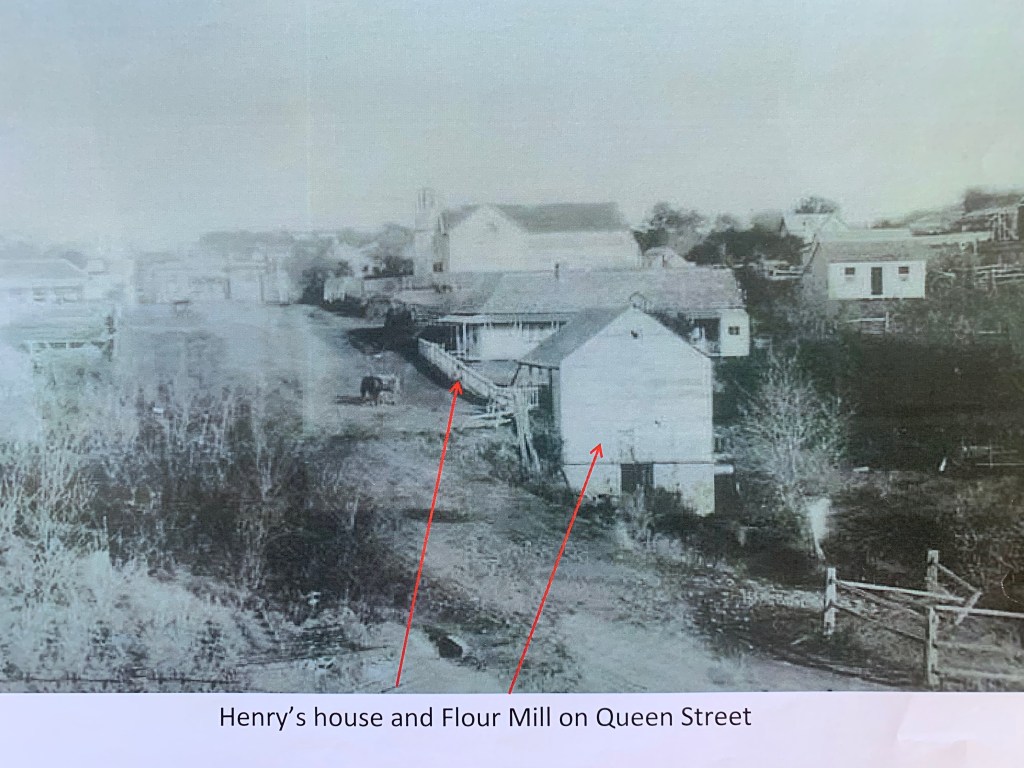
One of the Honeyfield children to move away from tenant farming, Henry took up an apprenticeship as a tailor for Style and Lowry in Salisbury and by 1851 had found work in London. The work was hard and so the prospect of being his own master by joining his siblings in New Plymouth and setting up his own business in New Plymouth had appeal. Henry went on to own several businesses in the fledgling economy in a number of endeavours including retail, flour milling, farming and land investment. In short, Henry was the most successful of the Honeyfield siblings in business terms.

The following is a letter that Henry wrote to his sister Matilda (who had immigrated to New Plymouth in 1850) while he was in London, describing what appears to be horrific working and social conditions at the time – and the strong contrast between life in London compared to Dorset – and the weight of uncertainty over his own decision-making in migrating to Taranaki. The letter also reveals how close the Honeyfield family was; that there seems to have been a broad circle of friends; and that Henry was a reflective but forthright and determined sort of fellow:

Lisson Grove [City of Westminster] London, 23 November 1851

My Dearest Sister,

I must say in the first instance I should have written before, but no news particular to relate. I have left Salisbury as you see; I left directly my apprenticeship expired and thot [thought] it better to come here a time to get a good knowledge of my business. I find it very different too. We do as much here in one week as we did there in a month.

It’s not a very large business, only 25 young men and 2 ladies. We live pretty well here for London. I came here on 20 October so I have been here a month. I was not satisfied with the situation at first and did not like it at all. The work is double as at Salisbury. We work very hard; it’s a very loss cutting trade just adapted for N.Z. I should think the profit is almost nothing but we do such a trade the shop is full from morn ’til night. We have no time for anything here. I would not live here for anything. I cannot think how I have stood it so long. There are not many who can.

I am getting a very good salary, taking everything into consideration. I think my Birth is worth 115 per annum, which is very well at first. I shall try and stop until Xmas if possible. We are expecting a letter from you before I decide about coming, in fact, I know not what to do. I want to please all if possible, but cannot. Some recommended me go, others not, but I don’t see the least hopes of my doing anything for myself here, that is to be my own master, not without stirring. I can do that when all other means fail.

If I was to be an assistant long, I would soon flee to the country for ease and comforts, as there are not many to be found here I can assure you. They don’t keep one here long if they don’t stop a week. They don’t think much of you if you break a rule you are discharged in 5 minutes, and they get another in your place before the day is over. Always plenty to take your place. I am oblige to open my eyes now, I can tell you. I have seen more in the world since i have been in town than ever before; everyone for himself here, and no mistake.

It’s no use to stick here as I cannot save much here. About getting married, I do not like to do that without some hope of a business to support us. I have a very nice lady in view, to whom I am very much attached, that is one of Mrs Read’s sisters whom you have heard me speak of. She is the youngest a quite a pet; her mother objects to our correspondence very much, but it has not much effect on us as where there is a will there is a way. i was there the day before I came to London and was made very welcome and happy.

John and James are at school at Marnhull [a village 12 kilometres south of Gillingham]. I saw them when I was at home. James seems determined to come with me if I come. I told him I shall not have him unless he was a good scholar; so he wanted to go to school directly, and went the following week. He is improving very much in manners and education – much better than John.

I heard from home this week; they are all well, and now must tell you their little news. They have heard of the arrival of the noble vessel Stately, which Bennet left in, so we expect some tidings of him soon – Auckland, 31st May, but no news of New Plymouth. They say Uncle at Longmoor sent letters about 3 weeks since. I suppose you would have heard of the baby’s death before this.

Your friends are so happy, and getting on well. Mr and Mrs Bell, Mrs Godwin in Devonshire, Mrs Thompson and Miss Hall and many others too numerous to mention desire their kindest respects to you and your beloved husband, wishing you every happiness and prosperity this world can offer you. Your last letter has fallen into the hands of many well-wishers known to you and many strangers, and all thing you very fortunate in getting so happy and comfortable. We have no weddings to relate to yet but expect that Robert and Sarah must be separated before long, as Sarah is engaged to John Morgan and Robert to Rhoda Howe. I expect it will take place in the spring, so I expect Robert is settled now at Woodwater [Farm]. I told him I would never stop in such a place was I so situated. I recommended him take up a sheep farm, but as he is content he will stay. I would not wish him to leave to please me.

I hope and trust William is well and proceeding well in business. I hope his leg is quite well.

I was home for about a fortnight. I went to Longmoor 2 or 3 times, and had a day shooting there, Charley with me, and we got on veryb well together. We killed 4 hares, 2 rabbits and 7 partridges, so I think we had very good sport, but Charley’s eye was not a very straight one, or we would have killed more.

I hope John and William are well, and doing well with their farming; am anxious to hear more from you.

One of our ladies here is going to be married soon, and going to Australia in January. They don’t know themselves what they are going to do.

I have sent you several newspapers. I dare say you have not much to read there. I think by the Journal that New Plymouth is in a very prosperous condition. I will send you any papers I get, but I don’t get any country news here, but will try and get some from my friends in Salisbury. I hope Bennet got a good voyage, and took care of your goods, and that you will find him very useful. Give him my kind regards when you see him.

I went to Stourton Caundle and saw Eliza; she is fully well, much better than I expected to see her, as she had been very ill, and was at Weymouth for 3 weeks for a change of air. The children are vey well and much grown. I made her promise to come and spend a day with me before I came here, and she did. Her man Charles drove her and Kate by pony, and also took them home. I am sorry to say they had an accident on the way home, was overturned, owing to some dog crossing the road. The pony stepped on it and was frightened, then began kicking and beat the gig to pieces, but am glad that neither of them were hurt much. They slept at Uncle William’s at Fifehead, and went home next day.

It’s no use to stick here, as I cannot save much. About getting married, I don’t like to do that without some hope of business to support us.

I must tell you that George Thompson has been to Gillingham nearly all Summer, and returned with me about 14th September. I was at their house for 3 weeks before I got into a situation. They often speak of you, and desire very kindly to be remembered to you. They behave very kindly to me. I have been there 2 Sundays, and am always welcome when I feel inclined to go.

There are plenty of amusements here, and plenty of work; I never knew what work was like before. I had plenty of pleasure before I came here, quite tired of a gentleman’s life. George and I went out a great deal, theatres and all such places, so I don’t care about it much now. Here we get out about 9 o’clock and in at 11 excepting Thursdays, when we have until 12, but I don’t want to go out, we’re all so tired, and can get anything we want here. Not like Mr Style (Salisbury Style & Gerrish, Drapers). We have 3 governors, and very pleasant ones. I have never herd an X word since I have been here, but such a place for work; if you don’t do your work you are soon about your business.

Respecting my coming, I know not what to do, but I expect I shall, sooner or later. Cannot say anything, but about March.

Father says I should be able to manage. What the result will be about my lover I know not, as it’s a very important step to undertake. I have not said anything to Father about it, and very little to Mother. I shall try to go home at Christmas, when I must hear their opinion on the subject.

It’s not much use to come out there (New Zealand), unless I have a good stock of goods with me, or I could get someone to send me goods as I want, I have no doubt I could do well. That is my view at present.

Three of Read’s sisters are married since you left, they are all doing well I am glad to say.

I don’t think I should like to bring her out with me, but I think it is best to come first and get a home, but don’t think Mrs Read will ever consent for her to leave England, that is her only objection I think.

I should have in first place congratulated you on the birth of your son and heir, but it was quite forgotten by me, which I hope you will excuse. We were all glad to hear you were doing well by cousin’s letter. I am quite anxious to hear from you. Hoping the baby and husband and yourself are well.

They at home desire their fondest love to you, your husband, William and cousins.

I remain, dear sister, your affectionate Brother, HJ Honeyfield.

At the age of 22 along with his younger brother, James Charles (aged 13) Henry departed London, England on 24 May 1852 on the Joseph Fletcher.  They arrived in New Plymouth almost five months later on the on 8 October 1852. Henry recorded a diary during the voyage, noting the incidence of smallpox onboard, catching flying fish and porpoise to supplement their diet, and that young James suffered a good deal from sea sickness.

The following is an edited extract from The Honeyfields of Taranaki, published in 2014 by Andrew Honeyfield, complied from research by various members of the extended Honeyfield family.

Henry took with him a stock of drapery and haberdashery goods and in 1853 he purchased an established drapery and general store from Mr G W Woon.

There is an interesting interconnection between Henry Honeyfield, William Morgan (who, with his brother John and his Honeyfield cousins emigrated to NZ in 1850) and the Woon family. William married Hannah Penfold. Hannah’s sister, Harriet, married Edwin Turner Wood – G W Woon’s brother. Andrew Morgan provided the following research note:

The Woon family name has significant history in early European settlement of New Zealand. Reverend William Woon was one of the first missionaries to New Zealand, arriving in 1834 and eventually settling in Wanganui around 1854.

Wanganui Old Settlers: The phamlet collection of Sir Robert Stout: Volume 76, nnzetc.victoria.ac.nz

After having got established in New Plymouth, Henry returned to England in 1854 to marry his sweetheart Eliza Read (referred to by Henry as Ellen). Henry returned to New Plymouth with his wife and with another of his younger brothers, Edmund Morgan, departing from Gravesend on 26 October 1855 on the Ashmore and arriving at New Plymouth five months later on 27 March 1856.

Henry acted as a guardian and mentor to his younger brother until Edmund came of age, when Henry assisted Edmund into a leased farm at Wanganui.

Henry’s business acumen in the new settlement of New Plymouth continued to play out well for him. In June 1859 he purchased a general store selling groceries, haberdashery and fancy goods, from Mrs Mary Hoskin. He imported silk and other fine cloth from Dorset, as well as wheat, flour, ryegrass seed, oats and farm implements.

Henry went on to engage in many other commercial interests. He was a director of the Taranaki Land Company, the New Plymouth Gas Company, the Steam Navigation Company, the Trustee Savings Bank, the Taranaki Land, Building and Investment Company and in 1873 became a partner in the Union Flour Mill with his brother-in-law Read.

Farming was another of Henry’s interests. Like his siblings, he acquired land very quickly and somehow, by 1857, he was offering a 57 acre farm for lease on Barrett Reserve A [acting, presumably, as an agent for Caroline & Sarah]. Henry brought a farm in Devon Street, near its junction with Hobson Street and later owned nearly 1,000 acres near Bell Block. He took a great interest in well-breed stock and is understood to have been the first to introduce the Hampshire Down sheep breed to New Zealand.

Just over 23 years after having written to his sister Matilda from London, still undecided as to whether to migrate to New Plymouth, Harry wrote the following letter to his brother, leaving no doubt that his decision to migrate was the best thing for him:

Dear Brother.

Yours of 18th November 1874 is to hand. I am glad to say we are all well. I am sorry to hear of the death of John Morgan so suddenly, although I always understood he was weak, suffering from heart disease. I hope his dear wife and family will bear up midst their great loss. I am glad to hear Uncle James is so hearty and that he visits you all so often. Give our kind love to him when you see him.

We have had a splendid harvest, all the crops well got in. The farmers are all holding out for more money than we can import for so we are not doing much with them as yet. I had to pay 5 shillings per bushel on Saturday last for some 2 or 3 thousand bushels of old wheat at 5/3 so this will do us now to come in to mix with the new. We have had plenty to do with the mill, last month we worked 24 hours per day. This month (we had) only one miller doing 12 hours to save the old wheat til the new comes in. I have written to Bamletts (?) about the self-reaper and files not sent and if they have not sent it on, to send me 2 combines instead. Also two, 2-horse reapers and told him to send you the income for payment, which please do on my a/c.

I am surprised and sorry Mr Burton has not paid you and that your boys have lost so much time in deciding what to do, as every month now tells, as all land and property is on the rise. Land that was 30/- per acre is now 5 pounds, so I have bought a piece adjoining mine at Henui – a paddock of 30 acres grassed and fenced with a sea frontage of about 30 chains which comes in and forms mine square. For this I paid over 6 pounds per acre and don’t get possession until 1 January 1876. So now I have mine square and compact with good boundaries, sea on one side, a river of 3 miles and the main road for the other. I have 580 acres in this piece (and) 150 acres in the bush close by.

Mr Rattenbury that called on father has just come out again as an immigrant. He is much surprised at the change. He has been looking after a piece of land, He came down to see my farm but thought it too much for him. 200 acres of it would do but this I did not care to part with. He has, I think, leased a piece now near Waitara. I shall soon sell or lease mine as it is too much for me to look after, so far away. I have a man and his wife living there just to look after the stock and fences. I have about 80 head of cattle and 8 or 10 horses so this will not pay. I hope to get your a/c soon and will do what you wish with regard to the overdraft. Money here is now tight and worth 8 percent. Lots of land in the market and all things looking up, with lots of work: roads, buildings, bridges, railway etc.

Hoping this will find you well and love to all, in which Ellen joins me.

I am, Dear Brother, Yours etc, HJ Honeyfield

Henry somehow found the time to be active in sporting and social activities, including the New Plymouth Cricket and Jockey Clubs. He was a Councillor on the Omata Riding of the local council, served on the Omata Roads Board and was a Justice of the Peace.

In July 1882, Ellen became ill with breast cancer. Although an operation was thought to have been successful, she died two years later at the age of 48 after a relapse.

Six months later Henry married Alice Brown Cotterell. Alice had recently arrived from Dorset and had lived with her aunt in New Plymouth.

During the 1890’s the New Zealand economy was depressed. To add to the problem, farmers were turning away from grain farming in Taranaki due to the regions unsuitably damp climate, and Henry’s flour mill was declared insolvent.

Regrettably, Henry took his own life in March 1898, aged 68. Henry is buried with his first wife in the Te Henui Cemetery.

A coronial inquiry commenced the day after Henry’s death. Henry had been suffering from chronic dyspepsia, and that would have the effect of affecting his mind. Henry’s physical ailments would be quite sufficient to produce and extreme state of mental depression. The jury returned a verdict of suicide while temporarily insane.

A letter was found in Henry’s pocket, addressed to his wife, stating:

Dear Alice, Forgive me for the bad deed I am about to do as I am too weak to undertake our journey, and I have not done my duty to my brother Robert’s children and cannot go to meet them, but make their share of my will to 2000 pounds so that they lose nothing by me; and may the Lord and Saviour have mercy on my soul. I feel too weak and mad about neglect.

At the time of his death Henry owned 911 acres of rural and commercial land in New Plymouth, Waitara, Urenui, Bell Block, Opunake, Kakaramea (near Patea) and as far away as Riverton in the South Island. The Merchantile Gazette estimated his Estate’s disposable assets at 17,464 pounds, a very sizable legacy in those times. In his will he left 167 acres to his niece Margaret Salway and her children and legacies to Kate Petty and to his nephew and executor of his estate, William Litchfield Newman. Small legacies were also left to the children of his brothers, Robert Honeyfield (in England), Edmund (Patea), William (New Plymouth), James (Tataraimaka) and to his sister Harriet Matilda Newman.

Alice Honeyfield moved to Sydney, Australia, but returned to New Plymouth for visits. She used Henry’s legacy to make many gifts to the citizens of New Plymouth, including the Honeyfield Fountain, Regina Place, new gates for the Te Henui Cemetery, the Kawaroa Park paddling pool. Alice, known as Aunt Alice to the Honeyfield family, died in Sydney in 1927.

Alice Honeyfield
Honeyfield Fountain, New Plymouth

News and updates, October 2018

Updates are made to this site as new information comes to hand. Several changes have recently been made, particularly to the posting on the Honeyfield migration to New Zealand. Additional material was sourced from a substantive research paper on the North Dorset Honeyfields authored by Ann Pearce and Frances Toogood that Anne Hodgson kindly sent me.

I would welcome any new material or feedback on this site so please do feel free to contact me.

Anne Hodgson has also set up a Barrett Honeyfield NZ Facebook group. The group has been set up for descendants of Richard (Dicky) and Wakaiwa Rawinia Barrett through their daughters – Caroline (Kararaina) and her husband James Charles Honeyfield, and Sarah (Hera) and her husband William Henry Honeyfield. If you would like to be added to the group please let me know.

Kevin and Jackie Honeyfield are hosting a celebration in January 2019 to mark 150 years of the Honeyfield family farm down Timaru Road, Tataraimaka. Part of the preparations is the collaborative development of  the ‘If Walls Could Talk’ document setting our accounts of the life and times of the extended Honeyfield family centered on the old Homestead and its antecedent Maori history.  Please let me know if you would like more information about these developments.

Paul Roberts

It’s a small world

Cate and I recently hosted two of our friends (Feleti and Janine) over the weekend and, while at the Matakana Farmers Market, we met a couple of their friends, including Ena Hutchinson who has a place in Leigh. As it happened we were all invited to Ena’s the following day and had a great time.

IMG_0503

As the discussion and the wine flowed, it turned out that one of Ena’s ancestors, George Ashdown, was a crew member on board the ship Adventure along with Dicky Barrett when, on their first trading voyage in mid March 1828 they were enticed to go ashore and set up a trading post at Ngamotu. George, like Dicky and at least several others of the crew soon had female partners from local hapu … so there possibly an ancestral link between us too.

What a small world then, 198 years later two ancestors of Dicky and George met and discovered their mutual links to that historical event in Aotearoa’s history. What a buzz that was! It was a real delight to meet Ena.

Ena and I proceeded to have a long chat that day about our ancestral links. One of the resources Ena has drawn on is The Interpreter, a biography of Richard ‘Dicky’ Barrett by Angela Caughey. Soon after when Ena joined Cate and I at our place I produced my copy of Angela’s book which I purchased soon after its publication in 1998. I’d had it in storage in New Zealand at the time of writing the postings for this blog while living in Australia.

So I have a good deal to add to and update my blog postings here with material Ena gave me, plus information from The Interpreter. This I intend to do over the next few weeks.


Status of this blog, May 2016

In the 10 months since this blog was created there have been 14 postings covering the lives of Richard and Wakaiwa (Rawinia) Barrett and the many Honeyfield’s and their extended family, stretching almost 170 years from 1807 to 1974 and reaching back much earlier – to the arrival of our Maori ancestors in Aotearoa in around 1350, and our English ancestry going back to the 17th century, with historical roots going back to Roman Britain.

Much of the source material has come from descendants, supplemented with my own research. Many of the initial postings have been refreshed with new information and analysis.

I have no doubt there is much more material to add… which will hopefully happen over time. But for now, I have posted that which is available to me right now. Please contact me if you have anything to add.

Meanwhile, I hope you enjoy what is here.

Paul Roberts