Updated 18 June 2024
Henry John Honeyfield was born at Langmore Farm, Gillingham, the fifth child of John and Hannah Honeyfield.
One of the Honeyfield children to move away from tenant farming, Henry took up an apprenticeship as a tailor for Style and Lowry in Salisbury and by 1851 had found work in London. The work was hard and so the prospect of being his own master by joining his siblings in New Plymouth and setting up his own business in New Plymouth had appeal. Henry went on to own several businesses in the fledgling economy in a number of endeavours including retail, flour milling, farming and land investment. In short, Henry was the most successful of the Honeyfield siblings in business terms.
The following is a letter that Henry wrote to his sister Matilda (who had immigrated to New Plymouth in 1850) while he was in London, describing what appears to be horrific working and social conditions at the time – and the strong contrast between life in London compared to Dorset – and the weight of uncertainty over his own decision-making in migrating to Taranaki. The letter also reveals how close the Honeyfield family was; that there seems to have been a broad circle of friends; and that Henry was a reflective but forthright and determined sort of fellow:
Lisson Grove [City of Westminster] London, 23 November 1851
My Dearest Sister,
I must say in the first instance I should have written before, but no news particular to relate. I have left Salisbury as you see; I left directly my apprenticeship expired and thot [thought] it better to come here a time to get a good knowledge of my business. I find it very different too. We do as much here in one week as we did there in a month.
It’s not a very large business, only 25 young men and 2 ladies. We live pretty well here for London. I came here on 20 October so I have been here a month. I was not satisfied with the situation at first and did not like it at all. The work is double as at Salisbury. We work very hard; it’s a very loss cutting trade just adapted for N.Z. I should think the profit is almost nothing but we do such a trade the shop is full from morn ’til night. We have no time for anything here. I would not live here for anything. I cannot think how I have stood it so long. There are not many who can.
I am getting a very good salary, taking everything into consideration. I think my Birth is worth 115 per annum, which is very well at first. I shall try and stop until Xmas if possible. We are expecting a letter from you before I decide about coming, in fact, I know not what to do. I want to please all if possible, but cannot. Some recommended me go, others not, but I don’t see the least hopes of my doing anything for myself here, that is to be my own master, not without stirring. I can do that when all other means fail.
If I was to be an assistant long, I would soon flee to the country for ease and comforts, as there are not many to be found here I can assure you. They don’t keep one here long if they don’t stop a week. They don’t think much of you if you break a rule you are discharged in 5 minutes, and they get another in your place before the day is over. Always plenty to take your place. I am oblige to open my eyes now, I can tell you. I have seen more in the world since i have been in town than ever before; everyone for himself here, and no mistake.
It’s no use to stick here as I cannot save much here. About getting married, I do not like to do that without some hope of a business to support us. I have a very nice lady in view, to whom I am very much attached, that is one of Mrs Read’s sisters whom you have heard me speak of. She is the youngest a quite a pet; her mother objects to our correspondence very much, but it has not much effect on us as where there is a will there is a way. i was there the day before I came to London and was made very welcome and happy.
John and James are at school at Marnhull [a village 12 kilometres south of Gillingham]. I saw them when I was at home. James seems determined to come with me if I come. I told him I shall not have him unless he was a good scholar; so he wanted to go to school directly, and went the following week. He is improving very much in manners and education – much better than John.
I heard from home this week; they are all well, and now must tell you their little news. They have heard of the arrival of the noble vessel Stately, which Bennet left in, so we expect some tidings of him soon – Auckland, 31st May, but no news of New Plymouth. They say Uncle at Longmoor sent letters about 3 weeks since. I suppose you would have heard of the baby’s death before this.
Your friends are so happy, and getting on well. Mr and Mrs Bell, Mrs Godwin in Devonshire, Mrs Thompson and Miss Hall and many others too numerous to mention desire their kindest respects to you and your beloved husband, wishing you every happiness and prosperity this world can offer you. Your last letter has fallen into the hands of many well-wishers known to you and many strangers, and all thing you very fortunate in getting so happy and comfortable. We have no weddings to relate to yet but expect that Robert and Sarah must be separated before long, as Sarah is engaged to John Morgan and Robert to Rhoda Howe. I expect it will take place in the spring, so I expect Robert is settled now at Woodwater [Farm]. I told him I would never stop in such a place was I so situated. I recommended him take up a sheep farm, but as he is content he will stay. I would not wish him to leave to please me.
I hope and trust William is well and proceeding well in business. I hope his leg is quite well.
I was home for about a fortnight. I went to Longmoor 2 or 3 times, and had a day shooting there, Charley with me, and we got on veryb well together. We killed 4 hares, 2 rabbits and 7 partridges, so I think we had very good sport, but Charley’s eye was not a very straight one, or we would have killed more.
I hope John and William are well, and doing well with their farming; am anxious to hear more from you.
One of our ladies here is going to be married soon, and going to Australia in January. They don’t know themselves what they are going to do.
I have sent you several newspapers. I dare say you have not much to read there. I think by the Journal that New Plymouth is in a very prosperous condition. I will send you any papers I get, but I don’t get any country news here, but will try and get some from my friends in Salisbury. I hope Bennet got a good voyage, and took care of your goods, and that you will find him very useful. Give him my kind regards when you see him.
I went to Stourton Caundle and saw Eliza; she is fully well, much better than I expected to see her, as she had been very ill, and was at Weymouth for 3 weeks for a change of air. The children are vey well and much grown. I made her promise to come and spend a day with me before I came here, and she did. Her man Charles drove her and Kate by pony, and also took them home. I am sorry to say they had an accident on the way home, was overturned, owing to some dog crossing the road. The pony stepped on it and was frightened, then began kicking and beat the gig to pieces, but am glad that neither of them were hurt much. They slept at Uncle William’s at Fifehead, and went home next day.
It’s no use to stick here, as I cannot save much. About getting married, I don’t like to do that without some hope of business to support us.
I must tell you that George Thompson has been to Gillingham nearly all Summer, and returned with me about 14th September. I was at their house for 3 weeks before I got into a situation. They often speak of you, and desire very kindly to be remembered to you. They behave very kindly to me. I have been there 2 Sundays, and am always welcome when I feel inclined to go.
There are plenty of amusements here, and plenty of work; I never knew what work was like before. I had plenty of pleasure before I came here, quite tired of a gentleman’s life. George and I went out a great deal, theatres and all such places, so I don’t care about it much now. Here we get out about 9 o’clock and in at 11 excepting Thursdays, when we have until 12, but I don’t want to go out, we’re all so tired, and can get anything we want here. Not like Mr Style (Salisbury Style & Gerrish, Drapers). We have 3 governors, and very pleasant ones. I have never herd an X word since I have been here, but such a place for work; if you don’t do your work you are soon about your business.
Respecting my coming, I know not what to do, but I expect I shall, sooner or later. Cannot say anything, but about March.
Father says I should be able to manage. What the result will be about my lover I know not, as it’s a very important step to undertake. I have not said anything to Father about it, and very little to Mother. I shall try to go home at Christmas, when I must hear their opinion on the subject.
It’s not much use to come out there (New Zealand), unless I have a good stock of goods with me, or I could get someone to send me goods as I want, I have no doubt I could do well. That is my view at present.
Three of Read’s sisters are married since you left, they are all doing well I am glad to say.
I don’t think I should like to bring her out with me, but I think it is best to come first and get a home, but don’t think Mrs Read will ever consent for her to leave England, that is her only objection I think.
I should have in first place congratulated you on the birth of your son and heir, but it was quite forgotten by me, which I hope you will excuse. We were all glad to hear you were doing well by cousin’s letter. I am quite anxious to hear from you. Hoping the baby and husband and yourself are well.
They at home desire their fondest love to you, your husband, William and cousins.
I remain, dear sister, your affectionate Brother, HJ Honeyfield.

At the age of 22 along with his younger brother, James Charles (aged 13) Henry departed London, England on 24 May 1852 on the Joseph Fletcher. They arrived in New Plymouth almost five months later on the on 8 October 1852. Henry recorded a diary during the voyage, noting the incidence of smallpox onboard, catching flying fish and porpoise to supplement their diet, and that young James suffered a good deal from sea sickness.
The following is an edited extract from The Honeyfields of Taranaki, published in 2014 by Andrew Honeyfield, complied from research by various members of the extended Honeyfield family.
Henry took with him a stock of drapery and haberdashery goods and in 1853 he purchased an established drapery and general store from Mr G W Woon.
There is an interesting interconnection between Henry Honeyfield, William Morgan (who, with his brother John and his Honeyfield cousins emigrated to NZ in 1850) and the Woon family. William married Hannah Penfold. Hannah’s sister, Harriet, married Edwin Turner Wood – G W Woon’s brother. Andrew Morgan provided the following research note:
The Woon family name has significant history in early European settlement of New Zealand. Reverend William Woon was one of the first missionaries to New Zealand, arriving in 1834 and eventually settling in Wanganui around 1854.
Wanganui Old Settlers: The phamlet collection of Sir Robert Stout: Volume 76, nnzetc.victoria.ac.nz
After having got established in New Plymouth, Henry returned to England in 1854 to marry his sweetheart Eliza Read (referred to by Henry as Ellen). Henry returned to New Plymouth with his wife and with another of his younger brothers, Edmund Morgan, departing from Gravesend on 26 October 1855 on the Ashmore and arriving at New Plymouth five months later on 27 March 1856.
Henry acted as a guardian and mentor to his younger brother until Edmund came of age, when Henry assisted Edmund into a leased farm at Wanganui.
Henry’s business acumen in the new settlement of New Plymouth continued to play out well for him. In June 1859 he purchased a general store selling groceries, haberdashery and fancy goods, from Mrs Mary Hoskin. He imported silk and other fine cloth from Dorset, as well as wheat, flour, ryegrass seed, oats and farm implements.
Henry went on to engage in many other commercial interests. He was a director of the Taranaki Land Company, the New Plymouth Gas Company, the Steam Navigation Company, the Trustee Savings Bank, the Taranaki Land, Building and Investment Company and in 1873 became a partner in the Union Flour Mill with his brother-in-law Read.
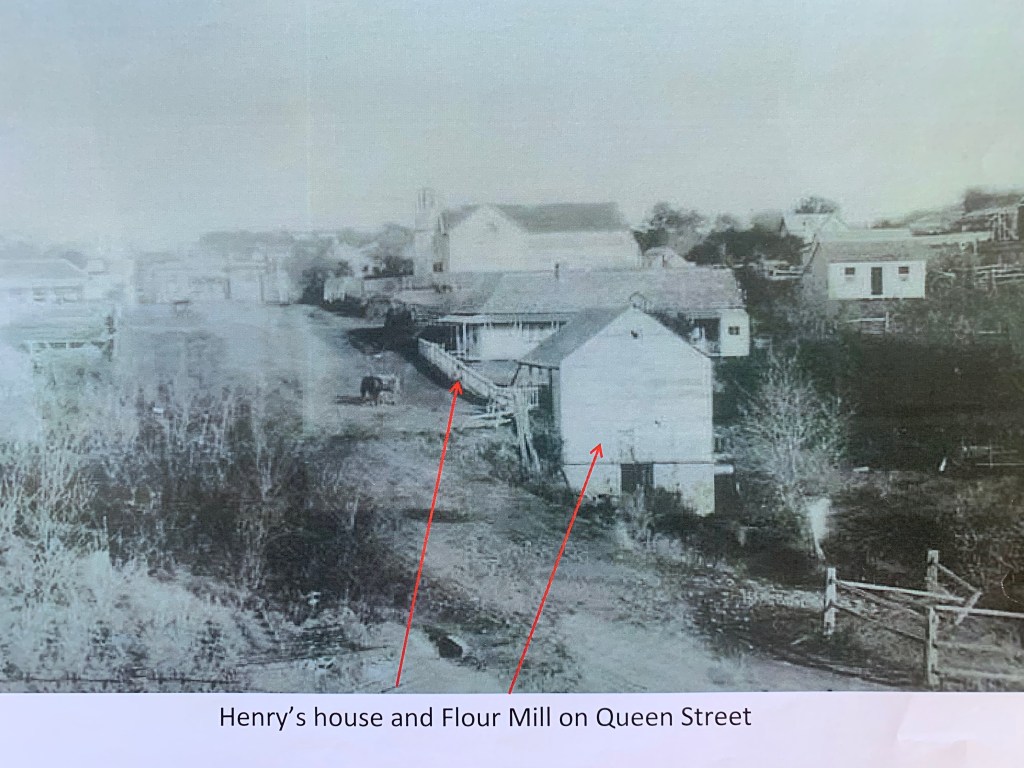
Farming was another of Henry’s interests. Like his siblings, he acquired land very quickly and somehow, by 1857, he was offering a 57 acre farm for lease on Barrett Reserve A [acting, presumably, as an agent for Caroline & Sarah]. Henry brought a farm in Devon Street, near its junction with Hobson Street and later owned nearly 1,000 acres near Bell Block. He took a great interest in well-breed stock and is understood to have been the first to introduce the Hampshire Down sheep breed to New Zealand.
Just over 23 years after having written to his sister Matilda from London, still undecided as to whether to migrate to New Plymouth, Harry wrote the following letter to his brother, leaving no doubt that his decision to migrate was the best thing for him:
Dear Brother.
Yours of 18th November 1874 is to hand. I am glad to say we are all well. I am sorry to hear of the death of John Morgan so suddenly, although I always understood he was weak, suffering from heart disease. I hope his dear wife and family will bear up midst their great loss. I am glad to hear Uncle James is so hearty and that he visits you all so often. Give our kind love to him when you see him.
We have had a splendid harvest, all the crops well got in. The farmers are all holding out for more money than we can import for so we are not doing much with them as yet. I had to pay 5 shillings per bushel on Saturday last for some 2 or 3 thousand bushels of old wheat at 5/3 so this will do us now to come in to mix with the new. We have had plenty to do with the mill, last month we worked 24 hours per day. This month (we had) only one miller doing 12 hours to save the old wheat til the new comes in. I have written to Bamletts (?) about the self-reaper and files not sent and if they have not sent it on, to send me 2 combines instead. Also two, 2-horse reapers and told him to send you the income for payment, which please do on my a/c.
I am surprised and sorry Mr Burton has not paid you and that your boys have lost so much time in deciding what to do, as every month now tells, as all land and property is on the rise. Land that was 30/- per acre is now 5 pounds, so I have bought a piece adjoining mine at Henui – a paddock of 30 acres grassed and fenced with a sea frontage of about 30 chains which comes in and forms mine square. For this I paid over 6 pounds per acre and don’t get possession until 1 January 1876. So now I have mine square and compact with good boundaries, sea on one side, a river of 3 miles and the main road for the other. I have 580 acres in this piece (and) 150 acres in the bush close by.
Mr Rattenbury that called on father has just come out again as an immigrant. He is much surprised at the change. He has been looking after a piece of land, He came down to see my farm but thought it too much for him. 200 acres of it would do but this I did not care to part with. He has, I think, leased a piece now near Waitara. I shall soon sell or lease mine as it is too much for me to look after, so far away. I have a man and his wife living there just to look after the stock and fences. I have about 80 head of cattle and 8 or 10 horses so this will not pay. I hope to get your a/c soon and will do what you wish with regard to the overdraft. Money here is now tight and worth 8 percent. Lots of land in the market and all things looking up, with lots of work: roads, buildings, bridges, railway etc.
Hoping this will find you well and love to all, in which Ellen joins me.
I am, Dear Brother, Yours etc, HJ Honeyfield
Henry somehow found the time to be active in sporting and social activities, including the New Plymouth Cricket and Jockey Clubs. He was a Councillor on the Omata Riding of the local council, served on the Omata Roads Board and was a Justice of the Peace.
In July 1882, Ellen became ill with breast cancer. Although an operation was thought to have been successful, she died two years later at the age of 48 after a relapse.
Six months later Henry married Alice Brown Cotterell. Alice had recently arrived from Dorset and had lived with her aunt in New Plymouth.
During the 1890’s the New Zealand economy was depressed. To add to the problem, farmers were turning away from grain farming in Taranaki due to the regions unsuitably damp climate, and Henry’s flour mill was declared insolvent.
Regrettably, Henry took his own life in March 1898, aged 68. Henry is buried with his first wife in the Te Henui Cemetery.
A coronial inquiry commenced the day after Henry’s death. Henry had been suffering from chronic dyspepsia, and that would have the effect of affecting his mind. Henry’s physical ailments would be quite sufficient to produce and extreme state of mental depression. The jury returned a verdict of suicide while temporarily insane.
A letter was found in Henry’s pocket, addressed to his wife, stating:
Dear Alice, Forgive me for the bad deed I am about to do as I am too weak to undertake our journey, and I have not done my duty to my brother Robert’s children and cannot go to meet them, but make their share of my will to 2000 pounds so that they lose nothing by me; and may the Lord and Saviour have mercy on my soul. I feel too weak and mad about neglect.
At the time of his death Henry owned 911 acres of rural and commercial land in New Plymouth, Waitara, Urenui, Bell Block, Opunake, Kakaramea (near Patea) and as far away as Riverton in the South Island. The Merchantile Gazette estimated his Estate’s disposable assets at 17,464 pounds, a very sizable legacy in those times. In his will he left 167 acres to his niece Margaret Salway and her children and legacies to Kate Petty and to his nephew and executor of his estate, William Litchfield Newman. Small legacies were also left to the children of his brothers, Robert Honeyfield (in England), Edmund (Patea), William (New Plymouth), James (Tataraimaka) and to his sister Harriet Matilda Newman.
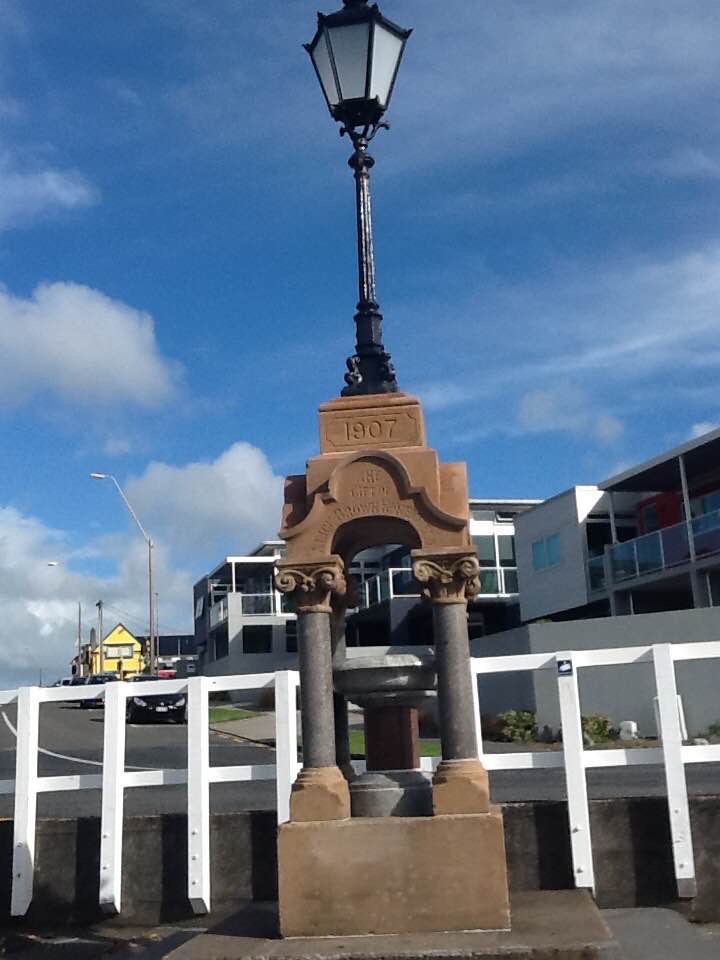
Alice Honeyfield moved to Sydney, Australia, but returned to New Plymouth for visits. She used Henry’s legacy to make many gifts to the citizens of New Plymouth, including the Honeyfield Fountain, Regina Place, new gates for the Te Henui Cemetery, the Kawaroa Park paddling pool. Alice, known as Aunt Alice to the Honeyfield family, died in Sydney in 1927.

 Barrett Honeyfield Te Atiawa Tūpuna / Ancestry: their lives, the times and their legacy
Henry Honeyfield’s younger brother who returned to NZ with him on the “Ashmore” in 1856 was not “Edmond Charles” as stated by you below. He was in fact Edmund Morgan Honeyfield aged about 13 who later settled at Patea.
LikeLike
Thanks Andrew. I’ve now put that right.
LikeLike