Revised, 28 December 2023
Long before the Waikato (a confederation of Tainui and Maniapoto) became a problem in the 1820’s and 1830’s, ongoing conflict between Te Ātiawa and their southern neighbours the Taranaki had been a historical norm since the 15th century. Te Ātiawa s relations with Ngāti Mutunga and Ngāti Tama to the north however, were much more cordial and the three friendly iwi combined in war with Taranaki. On occasion the Tainui and Ngapuhi further to the north and north-east also joined in the battles against the Taranaki. Ngā Motu lay at the southern boundary of Te Atiawa territory.
Map of “Taranaki Coast” beginning of 19th century
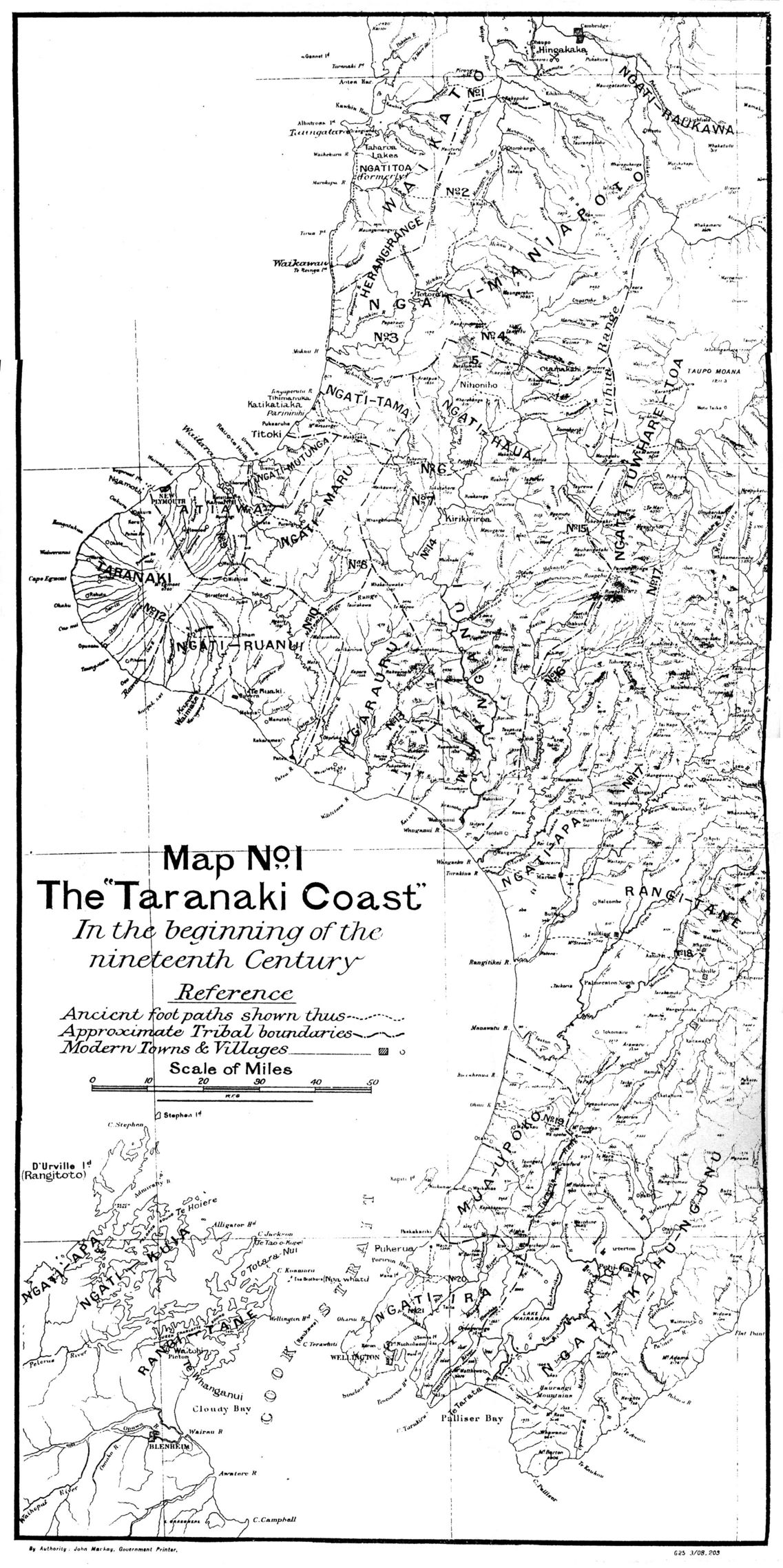
Source: http://nzetc.victoria.ac.nz/etexts/SmiHist/SmiHistP033a.jpg
In the first decade of the 19th century, the Taranaki iwi sought revenge for Te Ātiawa s attack and capture of Koru Pa (located on a bend of the Oakura River south of present day New Plymouth).
The Rewarewa Pā (occupied by the Ngāti Tawirikura hapu) was situated on the north bank of the Waiwhakaiho River between a bend immediately inside the river mouth and the sea. New Plymouth’s coastal walkway now crosses the Waiwhakaiho over Te Rewa Rewa Bridge.
Te Puni managed to evade the Taranaki iwi’s capture of the Rewarewa Pa. Te Puni and a fellow rangatira, Rawa-ki-tua made good their escape by plunging headlong from the cliff into the Waiwhakaiho and, emerging on the south side, ran over the sand hills and onwards to the safety of Te Ātiawa’s Pukeariki Pā (The Capture of the Rewarewa Pa by a Taua of the Taranaki Tribe – 1805-10, S. Percy Smith).
Te Ātiawa first saw muskets in action when Ngapuhi led a taua (war party) against Taranaki in 1816. It was the first of several Ngapuhi and Ngāti Toa (Kawhia) taua to the area. Due to the close relationship between Ngāti Tama and Ngāti Toa, there was no resistance to the taua from entering the region, and Te Ātiawa actually joined in the action against the Taranaki.
However, events changed for the worse for Te Ātiawa. Following skirmishes between Te Ātiawa and the Waikato, and the loss of several leading Waikato chiefs, the Waikato sought utu from Te Atiawa. Notably, the Waikato had been successful in obtaining muskets from Ngapuhi (who, by 1828, had a Pākehā trading station set up under John Kent, who settled at Kawhia).
So that they too could obtain a supply of muskets and other European goods, it became necessary for Te Ātiawa to have their own Pākehā trading station.
Having a trading station offered Māori other benefits from trade, including highly desirable goods that were new to them, such as iron pots for cooking, blankets, clothing and tobacco. Tribes in the far north of New Zealand had established the practice of offering chief’s daughters as a wife to entice traders to remain and set up trading stations to store and ship flax and other goods to trade (Wells).
Indeed, interaction between Europeans and northern iwi had been going on for many years since Cooks ‘discovery’ of New Zealand. American and British whaling from the early 1800’s provided considerable contact with Māori, particularly in the Bay of Islands. Providing the crews with food and other produce for shipping gave Māori many opportunities to trade for clothing and iron tools, nails, livestock and plants for horticulture. It was not unusual for young Māori to spend time onboard the whalers and traders, including taking trips to the penal colonies of Sydney (Port Jackson) and Norfork Island, and for some, as far as England (Salmond, 2018).
As well as whaling, British interests in particular viewed New Zealand as a source of flax and timber for shipping.
Those interactions were clearly beneficial to Māori and Europeans as they traded with one another for mutual benefit.
Moreover, New Zealand became a place of interest to the British for religious conversion purposes, with the Church Missionary Service holding its first service at the Bay of Islands on Christmas Day, 1814.
News of these interactions and the benefits would no doubt have filtered through to iwi further south, including Te Ātiawa.
There was a problem, however, in that trading ships had avoided the Taranaki region due to the lack of a natural harbour and rough seas. It was evident that Te Ātiawa had to take matters into their own hands … see the posting on Establishing a trading station at Ngamotu for more details.
 Barrett Honeyfield Te Atiawa Tūpuna / Ancestry: their lives, the times and their legacy

Pingback: Te Atiawa – Barrett Honeyfield Ancestry
Pingback: Ngati Te Whiti – Barrett Honeyfield Ancestry